
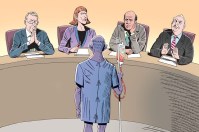
 Since this continues to be the number one searched post of Sparky’s Policy Pub, the timing seemed right for reposting (originally posted on 11/23/12).
I thought this would be a fitting topic for Black Friday. This post was inspired by a conversation I had yesterday with several of my Medicare-eligible family members who are adamant in their conviction that President Obama’s election victory meant the wonderful dinner we enjoyed would most likely be our last Thanksgiving together. Of course I’m just using hyperbole, right? Not as much as you might imagine.
Actually, it wasn’t much of a conversation at all. As the lone Democrat among a group of 12 that feel I am just an unfortunately misguided soul being controlled by the Dark Side, I really do more listening. And I watch, carefully – for any hidden cues they might send to one another signaling a political intervention that I am sure would include some form of immersion. But I digress.
At issue here is these intelligent, caring and concerned retirees harbor a genuine fear and loathing of the Affordable Care Act – in ways that I frankly believe are just not supported by reality. But why? The specific case in point is the promulgation of a piece being circulated around the Internet (enough said?) that apparently is encouraging seniors who may be contemplating knee replacement to have that surgery done soon because the procedure won’t be available in the near future due to rationing under Obamacare.
Now, someone with a working knowledge of healthcare would look at such a story and immediately question what on earth is that all about. Are the surgeons going on strike? Have hospitals and outpatient surgery centers determined the procedure is too risky? Have the part replacement manufacturers run out of titanium? I wanted to find out for myself, so I went to Google and searched for the news items in question.
And this is what I learned: this is a poignant example on how easy it is to start with a factual piece of evidence-based journalism from a well respected source and pervert it into fodder for conspiracy theorists and those hell bent on advancing a political agenda at the expense of innocent seniors. It also highlights the incredibly challenging task before us to educate the public on ACA implementation: the easy and the tough – and the realities that future demand on our healthcare system will bring about irrespective of public policy.
In the September 26, 2012 issue of the Journal of the American Medical Association can be found the article, Increasing Use of Total Knee Replacement and Revision Surgery. The article examines the increase in TKR surgeries (having grown from 93 thousand procedures in 1991 to 226 thousand procedures in 2010). It discusses several of the key drivers of the increase: e.g., the aging population, knee stress caused by a growing incidence of obesity, seniors’ desire to lead a more active lifestyle. It also addresses the rate of hospital readmission after TKR, increase in infection cases for revision cases and shifts in post-discharge care settings.
What the AMJA article doesn’t talk about is care rationing or death panels.
From this journal article, however, the Breitbart News Network’s Dr. Susan Berry created (and I do mean, “created”) a September 29th, 2012 story (note – this was before the election) entitled, Study: Obamacare May Make Knee Replacements Less Available to Seniors. In that article she referenced the JAMA study above and combined it with a quote from a Wall Street Journal article regarding the same research, entitled, Rise in Knee Replacements Boosts Federal Health Cost.
In the WSJ article, Dr. Peter Cram, the lead JAMA article contributor and a health-policy researcher and internist at the University of Iowa Carver College of Medicine, is quoted as saying, “Ultimately there’s going to be [only] some number of these we can afford,” The article also attributes the observation to Dr. Cram that, “how to limit the procedure or who should get it will be a ‘really contentious debate,’ .”
Dr. Cram makes a very reasonable point that is certainly worthy of discussion and debate – and has been for a long time before the Affordable Care Act among those who understand demographics and the reality of limited resources. He doesn’t even intimate, however, what might be the long-term result of that debate. But from that quote, Dr. Berry made the incredulous leap that such an observation is supportive of the nefarious motivation behind the ACA’s Independent Payment Advisory Board (IPAB) and the completely fabricated notion that the IPAB will be in charge of rationing care.
From Dr. Berry’s article:
Studies of this nature will likely be used to support the “necessity” of the ObamaCare Independent Payment Advisory Board (IPAB), the group of unelected officials who will be responsible for handing down the “rules” to physicians about who gets the knee surgery and who does not. The IPAB will, indeed, be in charge of “rationing” knee replacement surgery and other treatments and procedures, as well.
Apparently Dr. Berry has not read the Affordable Care Act. I did. The IPAB was created by the ACA under Sections 3403 and 10320 and is to be comprised of 15 full-time members. Of the 15, the President is required to solicit suggestions from Congress on 12. All members have to be confirmed by the Senate and may not hold any other employment. Each member will serve a term of six years, and only a minority of the 15 may be health care providers.
Beginning in 2015, if the projected rate of increase in Medicare spending (as determined by the Chief Actuary of the Centers for Medicare and Medicaid Services) is above specific targets, then at the beginning of the year the IPAB will make binding recommendations to Congress on how to reduce spending. If Congress does not agree with those recommendations, it must pass alternative cuts – of the same size – by August of that year. A supermajority of the Senate (at least two-thirds of those present) can also amend the IPAB recommendations. If Congress does nothing (its stasis), then the Secretary of Health and Human Services will implement the IPAB’s recommended cuts.
The ACA statutorily prohibits rationing. Here is directly from ACA, Sec. 3403:
The [IPAB proposal] shall not include any recommendation to ration health care, raise revenues or Medicare beneficiary premiums . . .increase Medicare beneficiary cost sharing . . . or otherwise restrict benefits or modify eligibility criteria.
Now, in the interest of fairness and equal coverage, there have been some good arguments advanced (not by Dr. Berry) that the IPAB’s functioning could lead to indirect rationing by restricting the amount of funding available to Medicare providers – and thus, access to the services and care they provide. But in lieu of the dramatic increase in demand for those services due to demographics, is it really the IPAB that should be of primary concern?
The real story here is another example where medical technology has created demand for a procedure that wasn’t imaginable when Medicare was started back in 1965. It’s a wonderfully successful procedure that has made a dramatic difference in the lives of many. But it’s not free to provide. And as we continue to run headlong toward the fiscal cliff, it is becoming increasingly obvious that we are not a nation of unlimited resources. The IPAB was created out of an earnest attempt to recognize that reality and remove the responsibility of addressing it from elected officials.
When there is significantly greater demand than the supply can meet, there will be rationing – the only issue to debate is who does the rationing, and how. But recognizing that someday not everyone may be able to have on-demand knee replacement surgery fully covered by Medicare is a far cry from all of the misguided rhetoric surrounding the IPAB and its fallacious association with death panels.
The ACA’s creation of the IPAB does not mandate rationing. It mandates that we recognize in order to control the growth in Medicare expenditures we will be forced to address certain economic realities. I believe that was the point Dr. Cram was making, which Dr. Berry took out of context to create a story that then got bastardized into another Internet myth. Unfortunately, those myths really scare good people that are trying to understand what is ahead of them – and how to be the best advocates for their own healthcare. That a physician would play a role in undermining that effort just to score some points on a news site with a particular political bent I find very sad.
But what do you think?
Cheers,
Sparky
 I am proud to have shared life on this earth with Jack Kennedy: sad to accept that it was but for a much briefer overlap than should have been; yet happy I grew up in a country that was influenced by his wisdom, reflective of his spirit of determination and embedded with his sense of compassion.
  This past Friday Rush Limbaugh took marked exception – yes, even for him – to Oprah Winfrey’s comments made during an
  … so why put them there? In this 21st century age of political correctness we bend over backwards in fear of causing an affront to any group that can call itself a group by virtue of having two or more like-minded people. And yet turn on any major news outlet and the jargon is awash with political stereotypes: the left, the right, the Dem’s, the Pub’s, the moderates, the Tea Party, etc., etc.
 One of my all-time favorite movies is
  Sparky's Policy Pub

The core challenge is in the one size fits all model of healthcare that currently exists. The system as a…
Reblogged this on rennydiokno.com.
I think you're absolutely right, Scot. We've passed the point of no return on Federal dysfunction.
It sounds like violence can change one's mind about what is right and what is wrong. I always thought that…
The important issue is not the comment that Gruber made rather the fact that he and the administration intended to…