
Do Hospital Amenities = Value?

Do Hospital Amenities = Value?

33ec2fbThere was an article in yesterday’s Dallas Morning News, Hospitals compete for patients with creature comforts, by Jim Landers that shares how hospitals are making huge capital expenditures in the name of patient satisfaction. The purported impetus behind this is in recognition of Medicare payments tied to patient-satisfaction scores under the Hospital Value-Based Purchasing Program. But there also has to be an element of competitive market positioning that is more to do with attracting a patient than satisfying a patient.

In either case, an obvious concern has to be to what extent, if any, more attractive aesthetics, better tasting food and higher speed Wi Fi access impact patient outcomes. Recall, Value = Outcomes / Cost. So what must be considered is how patient perceptions and experience factor into outcomes. Whereas one might  subscribe to a stricter definition of did the patient get well? others might want to consider is the patient happy?

From a policy perspective, to what extent should we be using tax dollars to make people happy versus making them well? From a holistic vantage point we want to consider those two objectives part and parcel of a singular goal. But again that old bugaboo raises its head: to the extent we measure achievement of a holistic goal by using objective criteria to assess subjective reality we risk wasting resources chasing an elusive butterfly.

Of course, the real irony here is that public policy designed to incent market-oriented provider behavior that improves value maybe doing more to increase the denominator than the numerator of the value equation. Makes you wonder whether we would be better off to just let the market develop solutions without artificial incentives – or whether it would make sense to stop pretending that healthcare is an industry that could ever provide value for a broad population left to its own devices.

Thoughts?

Cheers,
  Sparky

How Images (And Hugs) Can Change the World

How Images (And Hugs) Can Change the World

12-year-old Devonte Hart, Sgt. Bret Barnum share hug at Ferguson rallyIn 1604 Christopher Marlowe wrote these lines about Helen of Troy: “was this the face that launch’d a thousand ships and burnt the topless towers of Ilium?” The power of an image and its ability to evoke passion and emotion is ingrained in our history and social consciousness. This picture – and the story behind it – evoked so many personal feelings and emotions that I have had to sit quietly and alone for quite a while this Thanksgiving weekend determining what it was I wanted to share.

The photo above was caught by Johnny Nguyen at the start of a Ferguson rally being held in Portland, Oregon last Tuesday. Twelve-year-old Devonte Hart was holding a “Free Hugs” sign (more on that below) as he stood in front of a police barricade obviously upset.  Devonte’s mother, Jen Hart, is white, and she shared with reporters how her son has been struggling terribly to understand and reconcile his perceptions and understanding of what happened in Ferguson – and how race relations in his country will affect him as he grows into a man.

The officer pictured above, Sgt. Bret Barnum, works in the traffic division of the Portland police department and was at the site of the rally for crowd control. Standing about 10 feet from Devonte, officer Barnum noticed he was upset and called him over. They shook hands, chatted politely, Barnum expressing an interest in where Devonte went to school and what he had done this past summer. When asked why he was crying Devonte shared his concerns with the officer who empathized with those concerns. After they were done Barnum asked whether he might get one of the free hugs being offered. And thus be to infamy – maybe.

There was another time in our history when the camera captured an image that made a tremendous impact on the perception of race relations, but according to most accounts that image was not what it appeared to be. In his latest book, David & Goliath, Malcolm Gladwell relates the story behind this famous photograph of the civil rights movement in Birmingham, Alabama. The picture was taken by Bill Hudson of the Associated Press and shows 15-year-old Walter Gasden apparently being attacked by two police dogs during a May 3, 1963 protest in Birmingham.

But Walter Gasden was not a protester – he was a bystander who had been arrested by the officer in the photograph (Dick Middleton) for refusing an order to leave the street. It is believed that the police in the photograph are actually trying to hold the dogs back as Gasden strikes the dog with his left knee, causing it injury that required treatment by a veterinarian.

Diane McWhorter related this story in her book, Carry Me Home. Gladwell relied in part upon McWhoter’s account to relate how Wyatt Walker – an African American pastor and civil rights leader – had worked to confuse local authorities from being unable to distinguish protestors from bystanders in order to create chaos and a picture-perfect moment that had the purpose and effect Walker had hoped: it was printed in newspapers across the country with the understandable byline imagery of police using German Shepherds to attack a peaceful civil rights protestor.

Images can be incredibly powerful even when perception may not match reality (as in, perception is reality). A solitary image can profoundly impact a national cause just as a face can launch a thousand ships. Just as the image of a police officer accepting a free hug from a confused, scared and innocent youth can hopefully reset the dialogue we still desperately need to continue in this country on race relations, away from the hateful and destructive images of Ferguson that have perceptually hijacked that dialogue.

And what about those free hugs? The Free Hugs Campaign was started in 2004 by an Australian known under the pseudonym of Juan Mann (i.e., one man) in the Pitt Street Mall of Sydney.

imageI was first introduced to Free Hugs in 2010 when Sister Jill Bond of Catholic Health Service of Miami shared this 2006 video of the campaign shot in Hollywood, California (click on picture for link to the video). Set to the music of the late Israel Kamakawiwo’ole’s version of Over the Rainbow, it is one of the most captivating, inspiring and thought-provoking videos I have ever seen, and I have used it multiple times since in client workshops.

That it serves as an underpinning of the story behind the image of Devonte and Officer Barnum is emotionally compelling to me on multiple levels. In a time when technology has done so much to keep us connected it truly amazes – and depresses – me to realize just how disconnected we have become. And how way too often it seems our preference is to remain that way unless someone – like an innocent 12-year-old boy whose heart is full of love and wonder – has the courage to help us understand how simply powerful one hug can be – especially when it’s captured as an image that can be shared with others.

Cheers,
  Sparky

150-to-1 Reasons To Be THANKFUL

Sometimes the stars align. Sometimes your best efforts can make a difference. Sometimes you’re just in the right place at the right time. Tomorrow is Thanksgiving and this is the 150th post I have written for Sparky’s Policy Pub.

I had thought, for a brief moment mind you, of coming up with 150 different healthcare policy oriented reasons for being thankful and sharing them. But if there is one thing I have learned too well over the past 149 posts it’s that in a world of electronic media expanding at an accelerated rate it is extremely difficult to attract the attention of anyone interested in reading a paragraph – let alone a boring list – on public policy issues.

So I settled upon one policy-oriented reason to be thankful that is both timely and in keeping with the American heritage and tradition of Thanksgiving: I am thankful the Tea Party has gone into hiding, at least for now.

Writing this morning in Politico, Kyle Cheney asks the question: Is the tea party ready to chill out? Cheney posits that at least some portion of the Republican Party’s success is owing to their being able to smartly steer clear of TP challengers that historically have split the party against itself. And rather than swinging for the fences on every issue at least some TP strategists appear to be taking a more pragmatic approach, accepting that getting something – anything – is a lot better than getting nothing.

The Democratic Party is going to face its own fringe albatross dividing its constituency in the years ahead, particularly leading into the 2016 election. And their situation may be even worse because of some recent success the far left has had in influencing legislation. They have come to taste an unsustainable success that the Tea Party by and large has not. That will, of course, change, as Chuck Schumer and others have already begun signaling as they start to distance themselves from the party’s far left.

Politics in America can often best be characterized as a pendulum of public opinion: as the public comes to realize their lives are not better under one party they begin to have hope in the other. Of course, overall voter turnout earlier this month – at 36.4% – was the lowest it has been since 1942, perhaps an indication that 6 or 7 out of every 10 Americans have lost hope in either or any party, or could really care less about public policy until it is in some fashion proven to affect them directly.

That lack of interest in public policy is in good part because it has been overwrought by the rancor smell of partisan politics in an age of media-driven elections. The media’s complicity is our own: we like to be entertained, as I have written here before. Just ask ad agents at Fox News or MSNBC what type of programming advertisers will pay the highest rates to underwrite. Entertainment is found on the fringes of both parties because their behavior is usually characterized as aggressive, controversial and uncompromising.

But it’s the very lack of compromise that has thrown this country into a political tailspin. Without wanting to find myself disappointed to the point of joining the 7 out of 10 who don’t care what happens in public policy I hope the Republican Party’s ability to gain control of Congress is a harbinger of future hard fought debates on the floors of both chambers that will result in legislation that neither party loves but both can live with in the interest of knowing that doing something is better than doing nothing.

It will be interesting to see whether the likes of Ted Cruz, whose star for better or worse is at least for now firmly affixed to the Tea Party, will choose personal political ambition over progress and seek to make the 114th Congress as dysfunctional as the few before. Who wants to bet he’ll choose the road of constructive compromise? I’ll give you 150-to-1.

Happy Thanksgiving!

Cheers,
  Sparky

Ferguson and the Politics of Healthcare

Ferguson and the Politics of Healthcare

f01_59546488On August 9th, when campaigns across the country were beginning to ramp up for the 60-day sprint to the November elections Michael Brown was fatally shot during an altercation with a Ferguson, Missouri policeman, Darren Wilson. The circumstances of the incident – primarily that Mr. Brown had been unarmed – set off a firestorm of protests in the hot summer nights of this St. Louis suburb.

Those flames were reignited late yesterday afternoon when it was announced that the grand jury reviewing the case would not indict Officer Wilson on any charges stemming from the incident. From relief to acceptance to disappointment to outrage and insolence to rioting and looting, the decision has placed the nation’s issues of inequality front and center again ironically enough just before the Thanksgiving holiday.

In the final days leading up to the November 4th election Democratic Senate candidates in the South sought to use racial tensions as a tactic to encourage support and voter turnout of the African American population. As we know now that effort didn’t work out so well as Republican David Perdue defeated Democratic candidate Michelle Nunn in an open Georgia race while Republicans Thom Tillis and Tom Cotton defeated Democrats Kay Hagan and Mark Pryor in North Carolina and Arkansas, respectively.

If Bill Cassidy, the Republican candidate facing Democrat Mary Landrieu in Louisiana’s December 6th runoff election, wins (polls currently show he has a substantial lead), Republicans will have secured a 54 to 46 advantage in the Senate – a pickup of 9 seats and control of the United States Congress. And thus, if you were to believe the more optimistic sort in the Republican Party, they have secured a mandate to dismantle the Affordable Care Act, whether in total or piece by piece.

That was I believe, until yesterday. What is happening – what has happened – in Ferguson is community self-destruction on a par with some of the worst cases this nation has ever seen. The unsupportable actions of those rioting and looting belie and disguise the very real and troubling root causes of community and individual impoverishment that are at the heart of the anger and frustration playing out in Ferguson and across the country.

There are very real income and wealth disparities in this country, and they continue to get worse. I have maintained this is, in part, a byproduct of foundational and structural changes occurring in the US economy resulting from deindustrialization that could take several generations to play out.  It is clearly also the result of a failed welfare state that has irreparably influenced the social and individual psyche of what value means in a market economy.

Regardless of what got us here, with the chasm of inequity growing daily how can it be a politically practical reality that Congress should rescind the efforts to provide access to an affordable, minimum level of quality healthcare in this country? And with the aforementioned structural obstacles facing our economy how can we not seek to proactively reign in the runaway healthcare costs that are putting such a tremendous drag on economic growth?

Look deeper into what is happening in Ferguson and cities across the country. Recognize that under the foolish, destructive and misguided actions of the violent few is a growing population of impoverished from every race, creed and nationality in this country. How can we go backwards on healthcare now?

Cheers,
  ~ Sparky

Medicine’s Tragedy of OR

Thanks to Dr. Paul Wiseman for sharing the NY Times op-ed article,  How Medical Care Is Being Corrupted, via LinkedIn this afternoon. Article authors Pamela Hartzband and Jerome Groopmannov are on the faculty of Harvard Medical School and co-authors of Your Medical Mind: How to Decide What is Right for You.

    The article deals with an old nemesis in healthcare policy: individual incentives. More particularly, how the misalignment of individual incentives can often be the Trojan horse befalling well-intended policy initiatives.

    Idealistically, as patients we we want our doctors to have our best interests in mind at every touch point of our experience with them. And fortunately, I believe that continues to by and large hold true. But the forces pushing against physicians to maintain that altruistic objectivity and autonomy on our behalves is being vehemently tested by what the authors describe as, “financial forces largely hidden from the public [that] are beginning to corrupt care and undermine the bond of trust between doctors and patients.”

    Though coming from different sources the common thread is the push toward value-based payments. I have written here in the past on value and value-based healthcare. The theory is market-based sound logic: value = outcomes/cost. The challenge, as I have written before, starts within a few nanoseconds after you start to contemplate how to objectively assess outcomes and whose value are we talking about?

    As Hartzband and Groopmannov importantly note, there is a challenging conflict between what is perceived as valuable for population health (i.e., in the aggregate) versus what is valuable for individual health. Physician payment incentives are increasingly being created based upon broad public health metrics (e.g., incidence of hypertension and hyperlipidemia, which are both often treated with medications that can be very effective – but also have significant side effects that can vary significantly from one individual to the next).

    So it doesn’t take too many connected dots to imagine the potential conflict of interest between wanting to hit the metrics versus doing what’s in the best interest of the patient. And the challenges are compounded when it’s not just the rewards that are in play – but the potential punishment for not following prescribed protocols from third parties – e.g., poor ratings publications and/or loss of base payments. That’s what is known in the non-scientific world as getting it coming and going.

    So what the authors propose is the establishment of legislation that would make public information available on, “the hidden coercive forces” that could be at the root of physician-patient incentive misalignment due to the aforementioned consequences of well-intended policies. That may not be enough, but it’s an important recognition that the policies may not work as intended. I note, however, that they do not recommend going backwards to the past era of, “paternalism, where doctors imposed their views on the patient.”

    Progress often means a couple of steps forward and a few back. Trying, learning and adjusting. This is a fundamental difference in  thinking among healthcare policy types that believe we just have to give Adam Smith’s invisible hand wider breadth. Way back in 1995, Jim Collins (Good to Great) wrote an article, (Building Companies to Last), in which among other areas of recognition – that even back then noting that relying on lessons of the past would not suit us well in a world of transformational change – he discusses embracing the genius of the “and.” This is a theme that has pervaded much of his work since.

    Too often those critical of policy initiatives jump for self-satisfactory joy whenever they come across fair and objective criticism of those initiatives. But such criticism, if you can get by the politics (yeah, I know), doesn’t have to be viewed through the prism of the Tranny of Or. It can be viewed as an opportunity to learn and work toward the Genius of And.

    Cheers,
      ~ Sparky

Photo Credit: Alex Merto

Stupid Is As Stupid Does

If you haven’t heard or read about the recent uncovering of remarks made by Jonathan Gruber in relation to the crafting and passage of the Affordable Care Act (i.e., ObamaCare: pub patrons will note I rarely use that term even though I have largely supported it), then it is most likely because you are stupid. Yes, sorry, but that’s the sad reality of affairs according to intelligentsia types like Professor Gruber.

Aaron Blake writing in the Washington Post yesterday argued effectively that Gruber’s remarks will likely have little effect on any legislative initiatives to fully repeal the ACA. And as Kevin Drum pointed out in MotherJones, while Gruber’s choice of wording may have been very poor, he is right in noting that most of the electorate knows very little about public healthcare policy – if that’s what Gruber indeed meant. To me, stupid implies the inability to learn. I think Gruber may have accurately depicted an electorate that is disinterested in and/or unwilling to learn. Even still, I question how someone supposedly so smart could be so stupid.
Whatever term might best describe the initial benchmark of the electorate’s understanding of healthcare delivery, policy and regulations back in 2010, it has certainly advanced substantially from then. I’d like to think I’ve contributed a smidgeon since I started this blog in May of 2012. Whether the ACA is repealed, amended or dismantled one line at a time (parish the thought – I read the whole damn thing) healthcare public policy debate between January 2015 and the November elections of 2016 promises to be as energized, contentious and fraught with misinformation and misunderstanding as ever.

And knowing that, I am hoping to take the PolicyPub to a higher level next year. I am hoping to invite guest bloggers representing differing perspectives and backgrounds. Through my firm’s recent strategic alliance with Healthcare Lighthouse we are exploring ways to collaborate on sharing of healthcare public policy knowledge and information in ways that bring real value to organizations involved in healthcare. I am hoping to reenergize our free private discussion group where healthcare public policy is debated based on the merits of ideas and beliefs, and not sound bytes and news clippings.

To accomplish this I am going to need help. I am going to need to find others who share my passion for wanting to learn, understand and share their knowledge on the inner workings of healthcare public policy – and more importantly, the impact of that policy on patients and provider organizations. If you know of anyone who would be interested in adding to the discussion, please have them contact me.

I would like to commit myself in 2015 to proving how wrong Mr. Gruber is: not only is our electorate not stupid – but neither by implication are they willing to allow college professors to determine the future of our healthcare delivery system while they sit back and accept what’s given to them.

Cheers,
  ~ Sparky

What’s Next for Healthcare?

What’s Next for Healthcare?

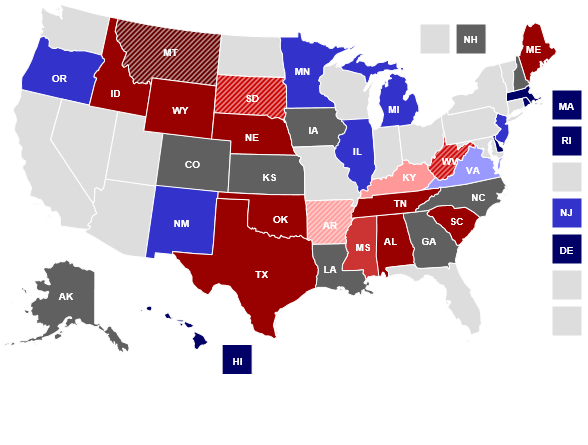
On the eve of this national midterm election polls are continuing to suggest a decided shift in congressional2014_elections_senate_map power. According to Real Clear Politics, current polling indicates 45 Democratic candidates are probable Senate winners, while 47 Republican candidates are positioned to be elected – leaving 8 races considered tossups. If voting plays out as polling suggests – and really, that’s a subject ripe and deep enough for a few hundred theses over the next decade I would think – Republicans only need to win half of those races to secure a 51-seat majority in the Senate.

The Affordable Care Act continues to be unpopular at around 38% of the country having a favorable opinion and 52% having an unfavorable opinion. With Republicans controlling both houses of Congress and their long-standing opposition one would think repealing the ACA would be priority one. But with President Obama’s unequivocal certainty to veto any attempt to repeal the ACA and 60 votes needed for cloture an outright repeal is unlikely. And candidly, a lot of Republicans are not anxious to take away parts of the Act that have proven popular.

So what is likely then. The Senate has never held a symbolical repeal vote, so it will be politically important to Republican Senators they have an opportunity to be on the record as voting for repeal. So we’ll have to endure that circus. Once past the political symbolism I think it is anyone’s guess what’s next. And that’s because it’s anyone’s guess who will ultimately control the soul of the Republican party.

There is the school of thought that a Republican majority in Congress would reflect a referendum on incumbency over frustration with that body’s inability to accomplish anything meaningful. To be sure, it would also be viewed as a referendum on the Administration. But another two years of meaningless symbolic gestures at the President’s expense might not play well for Republicans in 2016, which will be for even bigger stakes. While a more moderate tone from Republicans willing to find common ground with Democrats could lead to modifying and/or repealing the most unpopular aspects of the ACA.

On the other hand, strong-willed elements of the party’s conservative wing could once again seek to hold the Republican Party hostage in the name of being committed to their ideological base. Realizing their only chance of gaining popular support on a national level is to galvanize that ideology beyond current levels of support they don’t have much to lose by risking the ire of those who might view them as obstructionists.

If there were to be some revisions that somehow could be agreed upon by both parties, they would likely need to already have popular appeal – e.g., repeal of the employer mandate provision, repeal of the annual health insurance fee, repeal of the medical device tax – and possibly even repeal, or at least modification of, the individual mandate.

Why are these appealing? Because they lower costs to voters – whether directly or intuitively through the cost of doing business. What is far less attractive are things like repealing individual tax credits and cost-sharing subsidies for health insurance and funding of Medicaid expansion. That leaves a bit of problem for Republicans then, doesn’t it: cutting revenue without cutting expenses while seeking to be fiscally prudent as a primary positioning strategy ahead of the 2016 presidential election.

So how would this be political conundrum be reconciled? Hands, please.

My educated (as in reading the writing on the wall) guess is we will see even more pressure on providers to control costs and system utilization. More emphasis on provider risk sharing. Continued focus on value and tying outcomes to investment. Further support for capitation-based payment models via managed care. Oh, and increased pressure to embrace performance improvement and quality-based systemic approaches that have proven successful in achieving production efficiencies in other industries.

Whatever the outcomes of tomorrow – and however those outcomes manifest in the legislative and regulatory impact on the healthcare industry – all healthcare providers would do well to understand and accept that staying on top of state and federal activities is going to be crucially important to organizational survival.

Cheers,
  ~ Sparky

When Being Right Mattered

An American journalistic icon passed away yesterday. Ben Bradlee was the editor of the Washington Post during Bob Woodward and Carl Bernstein’s investigative reporting that was to become Watergate. Bradlee was the quintessential well-heeled news junkie with one foot on a banana peel and the other cemented firmly on the first step of the Lincoln Memorial: “with firmness in the right as God gives us to see the right.”

Bradlee was infamous for making it known that being, “right” is what mattered more than the means to knowing you were right. Getting it right wasn’t easy, and it wasn’t without mistakes. But getting it right mattered more than anything else.

Who can watch any news network today and feel even the slightest bit of confidence that getting it right is what really matters? Getting it first matters. Getting it with images matters. Getting it in a surreptitious fashion matters. Getting it right? Sure, why not if that doesn’t cost any more.

In the 1976 movie, All the President’s Men (based upon Woodward and Bernstein’s book of the same name) Jason Robards won an Academy Award for his performance portraying Mr. Bradlee. Last year Bradlee was awarded the Presidential Medal of Freedom.

I know I am being scornfully satirical and disingenuous in discounting the many journalists who still emulate Bradlee’s commitment to getting it right. Their inability to attract a larger audience that shares such an interest is a cultural reality beyond their control.

And yet how ironic is it that as we sit here in 2014 some of us are nostalgic for one of the darkest periods in American political history because we long for the truth – even when the truth might not be something we want to hear, or accept.

Cheers,
  ~ Sparky

More to Learn Than Fear From Ebola

More to Learn Than Fear From Ebola

ebolaEbola is scary. Though I try to allay my fears with practicality and common sense, I am – like many Americans – very concerned. The unknown is always scary. I wanted to start with that assertion to place the rest of my observations in context.

We will, I expect, ultimately pull through this latest threat to our lives better than our current fears would predict. Assuming we do, when the dust settles and the national media moves on to cover the next threat to our lives we are going to be left with some very useful case studies that we (hopefully) can use to assess how and why the healthcare industry continues to be unable to effectively embrace and utilize quality process improvement.

Of course, we will have to get past the blame game, name-calling and talking heads wanting to put the fault upon political philosophy rather than where it rightly belongs: the human beings that are involved in the promulgation of guidelines and regulations, the implementation of guidelines and regulations and the adherence to guidelines and regulations.

Already today pointed fingers are flying around Dallas like roof shingles might during a Texas size tornado. Texas Presbyterian hospital administration is accusing the media of sensationalism (go figure). A nurses union is blaming the hospital for not protecting its workers. The CDC blamed – then didn’t – the hospital for not following protocols and guidelines. How George Bush is avoiding blame down there I can’t figure.

Finger pointing in times of crisis is an innately human characteristic that only few people can avoid. Those folks that do avoid it tend to make very good leaders, and unfortunately apparently have an abhorrence for public office. But in a very real sense the finger pointing underscores how far the US healthcare delivery system has to go to change the systemic cultural aspects that impede progress toward quality improvement.

As I have shared in this space before, my colleague Nathan Ives and I wrote a white paper a while back: Aligning Healthcare Organizations: Lessons in Improved Quality and Efficiency from the Nuclear Power Industry. I believe it is informative and particularly relevant today to compare the relative safety records of both the nuclear power and airline industry safety records to healthcare. The potential wide scale impact of an epidemic raises our collective consciousness to view healthcare safety on a par with tragedies in those other industries in a way that one death at a time simply does not, however right or wrong that may be.

Though somewhat dated, there was an interesting journal article written in the December 2003 issue of Quality and Safety in the Healthcare: Applying the lessons of high risk industries to health care. In it the author notes the exemplary safety performance achieved in the oil and gas and aviation industries. And then examines why healthcare – an industry with comparable high risks – has not done nearly as well.

As the author notes, “health care has always taken medical dangers seriously, so the culture cannot be pathological. The lack of systemic risk management suggests that the culture is, at best, reactive, even though there may be the occasional proactive area.” Though we have seen the industry try and address these inherent cultural differences over the past decade since this research was conducted, we only need to look at the flying fingers in Dallas to realize not much progress has been made.

Organizational process improvement leading to the type of sustainable quality and safety that has been achieved in other industries and disciplines cannot and will not be achieved through regulatory compliance alone. It requires a paradigm shift in the thinking and attitudes of healthcare industry participants who have been effectively able to resist change for a long time. If you are looking for a silver lining in this scary period we are living through, it could be that Ebola accelerates that paradigm shift. I do believe we have more to learn than to fear.

Cheers,
  ~ Sparky

P.S. See you at the LeadingAge Conference in Nashville! We’ll be in booth 1829.

WARNING: Paradigm Shift Ahead

In light of the passage last Thursday by the Senate of S. 2553, the Improving Medicare Post-Acute Care Transformation Act of 2014, I thought I would re-share this post from July. 

If you are responsible for leading a post-acute/long-term care organization, I believe you should take note of two recent regulatory and legislative initiatives that provide a rather clear vision of where the post-acute/long-term care industry is headed – and it’s going to be disruptive to traditional thinking (if you want to survive).

ITEM 1: VBP in Home Healthcare
Earlier this week, CMS issued propose rule,
CMS-1611P, which proposed to update Medicare’s Home Health Prospective Payment System resulting in an over all 2.5% reduction in rates when consideration is given to rebasing adjustments and sequestration. Importantly, included with that rule was a solicitation of comments regarding a home healthcare value-based purchasing (HHVBP) model.

Section 3006(b)(1) of the Affordable Care Act directed the HHS Secretary to develop a plan for implementation of a HHVPB program for home health agencies and to issue an associated report to Congress. Key concepts of that report included building upon existing measurement tools and processes, the alignment with other Medicare programs and tying payment to performance.

As currently contemplated, beginning with CY 2016 in five to eight states participating in an initial demonstration, average Medicare payments would be increased or decreased in a rage of 5% to 8% based on quality performance as measured by both achievement and improvement across multiple quality measures. The belief is these incentives/disincentives would encourage better quality via improved planning, coordination, and management of care.


ITEM 2: Broad Spectrum Reform Targeted
Last week, leaders of the Senate Finance and House Ways and Means committees introduced bipartisan legislation (H.R. 4994, S. 2553) that would have the type of disruptive influence that Clayton Christiansen has researched and explained leads to
disruptive innovation. Being referred to as The Improving Medicare Post-Acute Care Transformation Act of 2014 (or, IMPACT Act of 2014), it would require data gathering and reporting standardization across different types of PA/LTC settings to facilitate better comparisons of quality and resource utilization among those settings and to improve hospital and post-acute care discharge planning.

The data collected and analyses completed would then be used to develop new payment system(s) that could be site-neutral and reflect various forms of bundling and/or at-risk capitation. Anticipated quality measures include functional status, skin integrity, medication reconciliation, major falls and patient preference. If enacted, SNFs, IRFs and LTACs would begin reporting some of these measures as early as October of 2016, with confidential feedback sent the following year and public reporting of the measures occurring in 2018.

Taken together, these two initiatives – even if neither is ultimately implemented – reflect the long anticipated but now swiftly emerging paradigm shift away from fee for service in the PA/LTC industry. They also reflect the migration toward a view of PA/LTC that encompasses the patient’s overall and entire experience after an acute care stay. Owning only a piece of the puzzle, without being able to seamlessly and economically integrate with healthcare providers holding the other pieces, will not represent a sustainable business model.

To reinforce this, simply look at the strategy of Kindred Healthcare. Writing in Forbes Magazine recently, colleague Howard Gleckman noted that,

“as recently as 2010, half of Kindred’s business was generated by its skilled nursing facilities. This year, only one-fifth of its revenues will come from its nursing and rehab centers. In a major strategic shift, Kindred is betting the company on in-home care, hospice, care management, and fully integrated care services.” [my emphasis added]

Ironically, PACE models – whose genesis dates back to the early 70s – are well ahead of the curve in successfully providing comprehensive, integrated services and care, though their positioning platform has primarily been a means of serving low income seniors. That road hasn’t been easy, as development and execution is fraught with financial, operational, clinical and regulatory challenges. But the overall long-term programmatic success demonstrates the value created from integrated care delivery under a fully capitated payment model (as in, see above).

So if you’re one of those individuals I referenced at the top of this post, what I would do if I were you is spend some time understanding the PACE model – and a crash course in organizational change management might not hurt either.

Cheers – and Happy Independence Day!!
  ~ Sparky