
Why Can’t We Be Friends?

Why Can’t We Be Friends?

Partisanship is as ingrained into the political fabric of this country as are the imported core ideologies from whence it sprang. The history of our domestic partisanship can be traced to the days of George Washington’s presidency with the establishment of the Federalist Party (led by Alexander Hamilton – being in favor of a strong federal government) and the Jeffersonian Republicans, which under Thomas Jefferson’s leadership advocated for strong state governments.

And our history is replete with examples where the individual and collective passions of partisanship have led to bitter conflict, even being manifested in physical assaults on the floors of both houses of Congress.

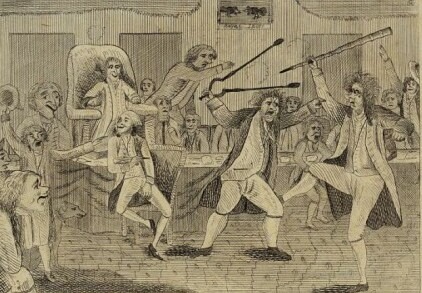
Shown below is a cartoon depicting a fight in the House of Representatives between Republican Matthew Lyon and Federalist Roger Griswold as depicted in this 1798 engraving. Lyon was the first member of Congress to have an ethics violation charged filed against him when he was accused of “gross indecency” for spitting in Griswold’s face (Griswold had called Lyon a scoundrel, considered profanity at the time).qAnd in 1856, at the heyday of debate over slavery, South Carolina Senator Preston Brooks – deeply agitated at what he considered Massachusetts Senator Charles Sumner’s libelous characterization of Brooks three days earlier in his infamous, “Crime Against Kansas” speech (at which Brooks was not present to protest) – used a metal cane to pummel Sumner, who had to be carried off the Senate floor.
So perhaps, in retrospect, the challenges of partisan politics standing in the way of addressing the nation’s fiscal crisis need to be taken in context. Or do they?

This morning, the Bipartisan Policy Center hosted a town hall meeting facilitated by USA Today’s Washington Bureau Chief Susan Page at the Ronald Reagan Presidential Foundation and Library to launch the Commission on Political Reform. Beginning today, the 30-member commission will be holding forums across the country in the hope of engaging a body politic unwittingly caught up in the maelstrom of political polarization that has been exacerbated and capitalized upon by a Media that serves a profit motive first and civic responsibilities somewhere south of fifth.

Take this, for example. In advance of the new Commission’s launch USA Today recently conducted a clever – albeit devious – poll in which it surveyed 1,000 individuals who were asked to assess two education polices: the first plan would reduce class sizes and make sure schools teach the basics; the second plan would increase teacher pay while making it easier to remove underperforming teachers.

Half of the respondents were told the first plan was a Democratic plan and the second a Republican plan. For the other half of respondents, the labels were reversed. In both instances, respondents overwhelmingly (by a margin of 3 to 1) favored the plan that was associated with their party affiliation. In fact, both sets of respondents were inclined to describe their support as being “strongly” in favor, regardless of which policy was represented.

The BPC’s President, Jason Grumet, in introducing this morning’s town hall panel was deliberate in noting the Commission’s purpose is not to create Kumbaya symmetry wherein political discourse becomes an effort to go along in order to get along. To the contrary, robust debate is needed now more than ever – because the complexity and urgency of the challenges facing our nation demand it.

But today, intelligent, productive discourse and debate is buried in sound bite rhetoric designed to be easily digested by a society in transit, always seeking first to be entertained – and then thoughtful and concerned. Along with that the tribal instincts of our modern social conscience have made the concept of political compromise tantamount to failure.  Since today’s town hall meeting was held at the Reagan Library, I thought it would be fitting to end this post with a quote from President Reagan’s autobiography.

When I began entering into the give and take of legislative bargaining in Sacramento a lot of the most radical conservatives who had supported me during the election didn’t like it.  ‘Compromise’ was a dirty word to them and they wouldn’t face the fact that we couldn’t get all of what we wanted today. They wanted all or nothing and they wanted it all at once. If you don’t get it all, some said, don’t take anything. I’d learned while negotiating union contracts that you seldom got everything you asked for. And I agreed with FDR, who said in 1933: ‘I have no expectations of making a hit every time I come to bat. What I seek is the highest possible batting average.’ If you got seventy-five or eighty percent of what you were asking for, I say, you take it and fight for the rest later, and that’s what I told these radical conservatives who never got used to it.”

Cheers,
  Sparky

Shades of Grey

Charlie Ornstein is a senior reporter at ProPublica and board president of the Association of Health Care Journalists. More importantly, he is the son of Harriet Ornstein, who passed away peacefully on January 18th of this year following a short stay in hospital. Last week, Charlie published an article relating his experience – How Mom’s Death Changed My Thinking About End-of-Life Care.

Reading Charlie’s article reminded me of the insights of Dr. John Henning Schumann, which I shared in my post, The Politics of Dying in America. Charlie’s experience is no different than that of hundreds of thousands of families every year. His perspective, however, is uniquely different because he is now in the unfortunate camp of having looked at end-of-life care from both an objective and deeply subjective vantage.

From a public policy perspective, the vulnerabilities of the American healthcare dragon are so easy to identify that you have to marvel at our inability to effectively exploit them. As Charlie points out in his article, about one-fourth of all Medicare expenditures are made during the last year of a beneficiary’s life. We are paying millions and millions of dollars to buy a few extra days. Doesn’t seem objectively reasonable does it?

What would you pay for one more day? Seeing as the day after one more day the collection agencies wouldn’t be able to reach me, I guess I’d pay whatever my credit would allow. That might get me through Good Morning America. On the other hand, my dad always told me that a noble goal was to leave the world indebted to no one while being the poorest soul in the cemetery. So I got that going for me . . .

Without any intention of being disrespectful to the cherished memory of Mrs. Ornstein, I make light of a scary and depressing topic simply because there isn’t much else to do with it that seems logical. And that’s where very often rational discussions of healthcare public policy breakdown: because one person’s calm, objective logic is another person’s emotional reality. I think this is at least partially what Charlie was getting at in his article.

The elasticity of demand for medical care is one of the most capricious concepts we face in analyzing and assessing healthcare public policy. What I would pay to stay alive another day is necessarily going to be different than what I would pay to keep someone I have never met alive. But the reality is that through public healthcare programs supported by taxation (e.g., Medicare and Medicaid) I do help pay to keep someone alive another hour, day – or hopefully, much longer. Fortunately, I’m not directly involved in that decision making because I cannot imagine what it would be like if I had to choose how my tax contributions should be used – or not – on a case-by-case basis.

The point of all this is while some folks involved in healthcare policy debate would have us believe the world is black and white – with clearly delineated focal points for determining what’s right and what’s wrong – it obviously is not. The real world is a thousand shades of grey between black and white and nowhere is that more evident than when the topic is end-of-life care.

Cheers,
  Sparky


The Political Realities of Sequestration

The Political Realities of Sequestration

imageNow be honest, before last summer had you ever heard the term, sequestration? Though I’m sure I did, I can’t recall when, and I am quite certain I wouldn’t have known the correct Jeopardy question, “What is the term used to describe the legal confiscation and possession of a defendant’s property in lieu of a judgment or court order?” And that’s not even the popular meaning now embedded into our political lexicon.

I have come to understand that Congress’ use of that term dates back to the 1985 Gramm-Rudman-Hollings Balanced Budget and Emergency Deficit Control Act in which it was used as a means of reforming Congressional voting procedures and intended to raise that body’s consciousness that budgeting should be a process of allocation from funds available – rather than an exercise in arithmetic reflecting the outcome of decentralized appropriations (insert favorite form of sardonic humor here).

The idea was that if the combined totals of appropriation bills passed separately by Congress resulted in spending in excess of the limits agreed to by Congress in the annual Budget Resolution, and then if Congress could not agree on ways to reduce that spending (or did not pass a higher Budget Resolution), then there would be an automatic reduction in spending: the aforementioned sequestration.  For me (and I’m sure many of you), this is a rather easy concept to understand because that’s how sequestration works in our house when our appropriations exceed our funding: we often call it, “cancelling our dinner reservation for Saturday evening.”

Back in fantasyland, however, the automatic reduction was to be sequestered by the Treasury and not disbursed as originally appropriated by Congress. In theory, the application of the sequestration is to be regarded pro rata across all agencies, though Congress has typically exempted certain programs such as Social Security and Defense.  The practical result has been that agencies not exempt would experience a disproportionate share of the spending reductions in order to achieve the total sequestration amount mandated.

As retired Senator, Phil Gramm, noted, “it was never the objective … to trigger the sequester; the objective was to have the threat of the sequester force compromise and action.”  Well, as we’ve seen, there is one thing that simply cannot be forced in Washington right now, and that is compromise. The reason for this is the stark contrast in political realities currently characterizing the two major parties.

The Obama Administration believes it won an electoral mandate to advance the country further in the direction of European style Social Democracy (different than Socialism, but closer than many in this country probably realize). And as Bob Woodward recently found out, they are taking a Machiavellian approach to whatever – and whoever – stands in their way. Woodward has lifted the curtain on the Administration, and he has garnered the attention and concern of a lot of folks, life myself, who have generally been supportive of it. And though I very much doubt it was his intention – or concern – he has created a strategic political opportunity for Republicans.

Unfortunately for their party, however, the Republicans are still wandering aimlessly in the sociopolitical dessert of the late-middle 20th Century, looking for the ghost of Ronald Reagan – or any ideological mantra that could garner greater than 50% support of their tattered leadership. In addition, because of the tremendous expense involved in campaigning in an era of modern media and super PAC’s (even in fending off same-party candidates in primaries), having party power of the House of Representatives is like having a gun with one bullet.  The party in power now gets one shot in a Congressional session to make a political impact.

So what we have is not a game of Chicken, where we wait to see which side blinks first.  We have a legitimate ideological stalemate that is being advanced and dominated by the promotion of minority interests holding sway over the respective parties. I say this because according to opinion polls I’ve seen, a significant majority of this country is in favor of raising taxes in order to pay down debt. What that majority is not in favor of is raising taxes to expand entitlements (there is also significant support for raising taxes and reducing entitlements).

The Administration wants to raise taxes to protect and expand the entitlements that are a critical component of their social agenda, while the Republicans want to reduce entitlements without raising revenue (taxes) so as not to alienate their primary campaign funding sources. The sad irony here is not that elected officials from both parties are acting selfishly in their political self-interests. That we’ve come to expect.  The sad irony is the perceived belief that placating minority interests is in their political self-interests more so than acting in harmony with the majority. Now, why is that?

Cheers,
  Sparky

It’s the Culture, Stupid

This post’s title is what I reminded myself of when I read the recent interview Megan McArdle did with Delos (“Toby”) Cosgrove, CEO of the Cleveland Clinic.  In that article, Can the Cleveland Clinic Save American Health Care? Dr. Cosgrove shares and explains several of the core elements behind the Clinic’s success. I was able to identify two concepts discussed by Dr. Cosgrove that I believe are more important to redefining healthcare in the United States than anything else: alignment of incentives and change management.  Both of these concepts are, in turn, major pillars of organizational culture.

And both are concepts, which transcend the argument that comparisons to organizations like the Cleveland Clinic, the Mayo Clinic, MD Anderson Cancer Center, Memorial Sloan Kettering, Johns Hopkins, et al) are often misguided and counterproductive because of the unique positioning and market advantages those organizations hold.

As Ms. McArdle writes in her article,

”Great institutional cultures can accomplish great things.  But in some ways, that’s a problem for the rest of us. It’s natural to want to emulate the achievements of [the] Cleveland Clinic in our policies. But you can’t make a culture out of rules. Culture is an organic outgrowth of an organization’s history, it’s people, its successes and failures. It cannot be ordered from the top, or nurtured by simply altering the financial incentives. Cosgrove speaks of maintaining the institution’s culture in much the way that he talks of maintaining their electronic health records system: a constant process of checking in, re-evaluating, and upgrading.”

But Cosgrove also believes the Clinic’s success can be replicated.  In the article he states that, “yes, other people can do it. One of the things that is beginning to drive this is the patient satisfaction scores that is now becoming part of the pay for hospitals ….” but “both the incentives and the culture matter. They’re inexorably tied.”

Creating a culture that instills and motivates behavior, which reflects incentives tied to desired outcomes – whether those are measured in terms of access, cost or quality and safety – is a difficult challenge that really does not get substantially easier or harder in relation to the size of an organization.  This is because – as my friend and colleague, Craig Anderson (National Director of Healthcare at Dixon Hughes Goodman) is fond of saying – “organizations don’t, never have and never will change – people change, one person at a time.”

And individual change is very hard for all of us.  It means being even more uncomfortable in a world of constant uncertainty.  It means not having the level of control you mistakenly thought you had in the first place.  It means letting go of some very deep-seated beliefs on how your environment should be ordered, arranged and understood.

To create the kind of culture that has been successful at the Cleveland Clinic requires an artful infiltration of the organization’s psyche. Careful attention must be given to long-standing relationships and patterns of behavior.  It is quite easy to do more damage than good. But if done right, the payoff can be a remarkable transformation from a healthcare organization inexorably floundering in reaction to its environment – to an organization that is emulated for proactively achieving great success, like the Cleveland Clinic.

Cheers,
  Sparky

Gun Control and the ACA

Gun Control and the ACA

imageThis is the second occasion I have had in the past four months to correct a news piece that has appeared on the Breitbart web site regarding the Affordable Care Act.  Last November, I shared my disagreement with Dr. Susan Berry’s fallacious interpretation of a Journal of American Medical Association article on knee replacements under the Affordable Care Act.

Interestingly, that post – Death Panels Just Won’t Die – remains the most popular PolicyPub article landed upon.  Visitors come to it by using search engines and wanting to learn more about “Obamacare and knee replacements.” But today I am writing about Awr Hawkins’ piece from January 9, Obamacare Amendment Forbids Gun and Ammo Registration.

A good friend brought this to my attention via  forwarded e-mail. As with many topics of this type, the news gets passed around in emails, blogs and web sites and then reproduced, repurposed and morphed into all varieties of content (just as I am doing here).  As I did in my post on death panels referenced above, however, I will try again to be diligent here in providing to readers original source content, so that you can do your own research – and thinking.  I wish Mr. Hawkins had gone to such effort.  Here is what he wrote:

“Good news — it has become known that hidden deep within the massive 2800-page bill called Obamacare there is a Senate Amendment protecting the right to keep and bear arms.

It seems that in their haste to cram socialized medicine down the throats of the American people, then-Speaker Nancy Pelosi (D-CA) and Barack Obama overlooked Senate amendment 3276, Sec. 2716, part c.

According to reports, that amendment says the government cannot use doctors to collect ‘any information relating to the lawful ownership or possession of a firearm or ammunition.’

CNN is calling it ‘a gift to the nation’s powerful gun lobby.’

And according to Senate Majority Leader Harry Reid (D-NV), that’s exactly right. He says he added the provision in order to keep the NRA from getting involved in the legislative fight over Obamacare, which was so ubiquitous in 2010.”

In his piece, Hawkins references an article produced by HotAir.com, which, in turn, references a video report produced by CNN on the subject that Hawkins’ references in his article (following, so far?).  What the original reporting claims is that Title X, Sec. 2716, Subsection C was a, “little known” piece of the Affordable Care Act that was unwittingly passed in support of the gun ownership lobby by lawmakers whom many would assume are gun control advocates.  In particular, Harry Reid.

As the CNN piece points out, however, up until very recently, Harry Reid has been a rather reliable gun rights advocate.  More importantly, as Ed Morrissey writes on the HotAir site, “this isn’t that much of a bar on Congressional action. What can be done in this manner can be undone in the same manner.”

Even beyond Mr. Morrissey’s interpretation, however, what the above referenced section does is make it explicit the ACA does not empower the Federal government (primarily under the Secretary of the Department of Health and Human Services) with the right to collect, analyze and/or report data and information on gun ownership.  And it was rather widely understood at the time (sorry conspiracy theorists) that in order to achieve some measure of political support of the ACA by the Gun Lobby, this section was intended to provide assurance the ACA was not granting new Federal powers.

That is not the same thing as saying such powers have been henceforth forbidden or cannot be achieved through other means (i.e., through future legislation).  In other words, if Congress were to advance gun control legislation currently under consideration that requires stricter registration, tracking and reporting of gun ownership, there is nothing in the ACA that would conflict with that legislation.

President Obama recently issued 23 executive actions on gun control.  One of these is to, “clarify that the Affordable Care Act does not prohibit doctors asking their patients about guns in their homes." This has also been unfortunately interpreted by some media sources as a new Federal requirement that doctors are being required to act as deputies in ferreting out individuals at risk of committing gun violence.

In any event, while speaking on gun control during last week’s State of the Union, the President noted that, “each of these [gun control] proposals deserves a vote in Congress.  If you want to vote no, that’s your choice. But these proposals deserve a vote. Because in the two months since Newtown, more than a thousand birthdays, graduations and anniversaries have been stolen from our lives by a bullet from a gun."

What I believe this to mean is the President does not have the votes in Congress to pass any meaningful gun control legislation at this time.  But he is seeking to gain some measure of political capital by getting those opposed on record.

This is a very difficult ball of public policy yarn: wrapped in together you have healthcare delivery policy, mental health policy and gun ownership/gun control policy.  It requires serious efforts in research, understanding and debate.  It requires, wherever possible, a clear articulation of the known facts.  Although my readership is paltry compared to what Breitbart controls, I hope my efforts here will combat this latest demonstration of reporting laziness, manifested in unhelpful misinformation.

Cheers,
  Sparky

Blog post picture courtesy of www.sodahead.com

Update: Hospital Readmissions

Hospital Readmissions continues to be a driving topic of concern, debate and contention in the healthcare industry.  It also continues to be an area of great interest for potential partnerships between acute and post-acute care organizations.  Whether that interest is warranted based upon expected improvement in outcomes and cost reductions remains to be seen.

JAMA Study: Assessing Program Risk
On Tuesday of this week the Journal of the American Medical Association published a study, which looked at the relationship between risk-adjusted mortality and 30-day hospital readmissions.  The reasons for testing this relationship are because of concern that artificial incentives will drive behaviors with unintended consequences.

First, the concern is that hospitals may invest resources to lower readmissions for targeted conditions at the expense of quality care for other conditions.  Second, there is concern that patients may not cared for in an environment that is determined by clinical needs and requirements, but instead by financial considerations.  For those who believe these concern are overstated the results of this research will serve to reinforce their perception. 

Data was analyzed for Medicare beneficiaries admitted to hospitals between July 2005 and June 2008 with a heart attack, heart failure and pneumonia. These are the three conditions hospitals are now being penalized for 30-day readmissions under the Medicare Hospital Readmissions Reduction ProgramAccording to the study, “risk-standardized mortality rates and readmission rates were not associated for patients admitted with an acute myocardial infarction or pneumonia and were only weakly associated, within a certain range, for patients admitted with heart failure.”

RWJ Foundation: Revolving Door
Another report released this week, by the Ro
bert Wood Johnson Foundation, found that hospitals and their partner relationships made little progress from 2008 to 2010 at reducing hospital readmissions for elderly patients.  Using new Medicare data from the Dartmouth Atlas Project, researchers found , “one in eight Medicare patients were readmitted to the hospital within 30 days of being released after surgery in 2010, while one in six patients returned to the hospital within a month of leaving the hospital after receiving medical care. Patients were not significantly less likely to be readmitted in 2010 than in 2008.”

The report also shares findings from interviews with patients and providers that sought to better understand the root causes of patient readmissions.  While some portion of those readmissions were either anticipated or necessary, there were also a significant number of readmissions that could primarily be attributed to non-clinical considerations, such as discharge planning, the individual’s support system, care coordination and the availability of primary care post-discharge.

So what to make of this? Research is continuing to support the hypothesis that cost savings are achievable by creating better alignment of care requirements and care settings without sacrificing quality.  The ways in which providers achieve such savings, however, are no clearer today than they were several years ago.  Also up for debate is whether the Hospital Readmissions Reduction Program is providing a meaningful incentive to drive innovation – or whether providers are reacting to market realities (likely some combination thereof).

What does not seem to be up for debate is the reality that proactive healthcare providers are pushing integrated delivery models that seek to facilitate better resource alignment.  Are you one of those organizations?

Cheers,
  Sparky

Pick a Price, Any Price

Pick a Price, Any Price

imageIn today’s edition of the Journal of the American Medical Association: Internal Medicine is a new research article that spotlights the challenges the average consumer faces in navigating the healthcare system.  Researches  Jaime Rosenthal, Xin Lu and Dr. Peter Cram share the results of their research on, Availability of Consumer Prices From US Hospitals for a Common Surgical Procedure.

They selected 20 of the nation’s top-ranked orthopedic hospitals, according to US News and World Report rankings, and using a secret shopper script (one of the author’s 62-year-old grandmother who did not have insurance but had considerable means to pay privately), requested from each the lowest complete bundled price (i.e., including hospital costs and physician fee) for an elective total hip arthroplasty (THA, or hip replacement).    They also contacted 102 non-top-ranked hospitals to request the same information.  What they found was considerable variability in the hospitals’ ability to respond to the request – and the range of prices quoted where responses were received. Each hospital was contacted up to 5 times.

The tables below (taken directly from the article) show the research results.  Table 1 indicates the number and percentage of hospitals unable to provide a single, bundled cost for a THA (55% of the top-ranked hospitals and 90% of the non-top-ranked hospitals).  Table 3 illustrates the significant in pricing. The range of prices for those top-ranked hospitals able to respond with a payment bundle was between $12,500 and $105,000.

image   

   Image not available.

This research is hardly going to come as a surprise to those familiar with the economic realities of the US healthcare delivery system. It would have been more surprising if the results were reversed.  Healthcare cost accounting has for decades now been driven by incentives that seek to allocate costs for the purpose of maximizing third-party reimbursement and not for the purpose of understanding production costs per unit of service/care similar to what you would find in any manufacturing sector.

In September 2011 Robert Kaplan (of the Balanced Scorecard fame) and Michael Porter (Redefining Healthcare) wrote an article for Harvard Business Review, How to Solve the Cost Crisis in Healthcare.  While I challenge both the immediate practicality and scalability of their approach, it was a strong effort to advance the cost allocation discussion from the bottom up, instead of the top down as we are used to doing.

But here’s the key takeaway: Consumer-Driven Healthcare must play a critical role in the future of the US healthcare delivery system.  Debate surrounds what policies best encourage and promote CDH and to what extent consumers can truly be their own advocates in a system where even prices are hard to understand (or believe).

Regardless of policy, however, healthcare providers – and hospitals in particular – are realizing quickly how important it is in an era of hyper-competitiveness, higher costs and shrinking reimbursement to understand costs the way a Lean manufacturing concern understands costs.  We’re heading in the right direction.

Cheers,
  Sparky

Leadership Opportunity for Hospice

Leadership Opportunity for Hospice

imageIn an article that has received a good amount of advanced press, today’s Journal of the American Medical Association publishes research findings on end of life care, or more particularly, utilization of hospice care.  The article, entitled, Change in End-of-Life Care for Medicare Beneficiaries: Site of Death, Place of Care, and Health Care Transitions in 2000, 2005, and 2009, shares the findings of research seeking to determine changes in site of death, place of care and care transitions for Medicare decedents between 2000, 2005, and 2009.

Research results indicated that while more individuals aged 65 and older are dying at home, their utilization of intensive care services (i.e., hospital ICU) during the last month of life increased (29.2% of decedents utilized ICU in 2009).  In addition, 11.5% of decedents in 2009 had three or greater hospitalizations during the last 90 days of their lives.  And while hospice use increased, upwards of 28% used hospice services for three days or less in 2009.

A key finding of the research is that increased use of hospice may not lead to a reduction in resource utilization.  The authors believe their findings could, “raise concerns that hospice is an ‘add-on’ to a growing pattern of more utilization of intensive services at the end of life.” Hospice providers hoping to avoid the sequestration axe take note: while your inherent value proposition of improving the quality of life, while easing the individual pain and family burden associated with end of life care is invaluable, getting paid for your efforts in this environment also requires demonstrable cost savings.

As I have written here before, the Death Panels moniker given to us courtesy of Sarah Palin has been a tremendous disservice to encouraging open and candid discussion on the personal, social and economic challenges of dealing with end of life care.  But I see a huge opportunity here for hospice providers – and the trade associations that represent them – to seize this important initiative back from politicians and elected officials.

They should use this opportunity to take a leadership role in creating a national framework for encouraging candid dialogue, open sharing of concerns, fears and ideas – and for advancing policy initiatives that encourage knowledge and education regarding the alternatives available to individuals and their families facing end of life decisions.

Oscar Wilde wrote that, “life is too important to be taken seriously.”  Well, I posit that death is too scary to run in fear from.

Cheers,
  Sparky

Chaos Theory & Doc Shortage

A major concern of policy analysts regarding the Affordable Care Act is whether and how the country will be able to produce a sufficient supply of primary care physicians (PCPs) to meet the projected demand arising from extending healthcare coverage.  But to what extent future demand for PCP services will be owing to demographics versus expansion in coverage requires the use of some rather subjective assumptions.  While it is plausible to assume that removal of cost as an obstacle to healthcare utilization would increase demand among that portion of the population unable to afford coverage, such thinking can also be counterintuitive.

According to a 2012 article published in the Annals of Family Medicine, Projecting US Primary Care Physician Workforce Needs: 2010-2025, “with nearly 209,000 PCPs in 2010, the United States will require almost 52,000 additional PCPs by 2025—about 33,000 to meet population growth, about 10,000 to meet population aging, and about 8,000 to meet insurance expansion.”  There are numerous similar studies using different methodologies and approaches and different (hypothetical) assumptions, but most all I have seen support the challenging reality that demand for PCP services is going to substantially outpace supply given the historical rate at which new physicians enter the workforce.

In reaction to this concerning challenge, the journal Health Affairs recently published a paper that argues the projected PCP shortage can be largely addressed by using teams, better information technology and sharing of data, and non-physician professionals (i.e., physician extenders, such as Registered Nurses, Physician Assistants and/or Nurse Practitioners).  I fear again, this may be a situation where the reliance on subjective assumptions produces desirable findings from sound research practices that won’t bear out over time.

I think it also illustrates – and this is really the larger point I wanted to make with this post – where very often healthcare policy research methodologies inherently rely upon linear dynamics to study problems that really require a nonlinear dynamics approach.  And understandably so.  If you want to produce a movie using a still frame camera, you had either be extremely fast or quite imaginative.  You work with the tools at your disposal.

As advances continue in information technology computing power and capacity (i.e., Big Data), the ability to model nonlinear relationships will increase.  But the nature of unpredictability in human reactions to environment and circumstances will still be a difficult challenge.  There is quite a body of interesting literature suggesting ways in which nonlinear dynamics (e.g., Chaos Theory) can be adapted in social policy research, which is well beyond my purpose here.  But to be sure, the observations I offer on the subject are neither unique or original.

As a more practical matter, however, I think the ideas presented in the Health Affairs paper are viable and will probably result from being as much a function of necessity as requiring support of public policy.  But the nature of how these clinician-patient relationships form and whether or not they will be sufficient to meet the projected demand for PCP services really cannot be predicted because of the modeling constraints of linear dynamics.

Unfortunately, there are usually significant limitations to what healthcare policy research can offer in terms of predicting the future benefit of what appear to be good ideas.  On the other hand, fortunately, the lack of a projected empirical benefit has not been an obstacle to the pursuit of good ideas throughout the history of mankind.  The historical resolution of these two realities has always been the economic reward for the risk taken in pursuit of an idea that lacks a demonstrable benefit.  The challenge we face today is our inability to accept the consequences when that pursuit does not bear fruit.

We love being rewarded.  Paying the Piper – not so much.

Cheers,
  Sparky

The Politics of Dying in America

Please take a few minutes to read the post, One Example of End-of-Life Care in America, written by Dr. John Henning Schumann on his blog, GlassHospital.  It relates the real life story of a general internist’s experience treating a frail 94-year-old female patient with advanced Alzheimer’s disease and multiple medical issues.  It shares the difficult, non-medical oriented challenges that cut a wide swath across the care continuum when dealing with end-of-life care: the patient, her family, the hospital administration, the attending physician and other clinicians at the hospital.

Several healthcare policy themes are also inherent in this story: the apparent shortcomings of clinical integration and misalignment of incentives that are too often manifested in simply poor communication between clinicians, the challenges with assignment and fulfillment of responsibilities pertaining to an advance directive, the relative effectiveness of evidence-based medicine and how to meaningfully and consistently define transparency in lieu of individual privacy and respect for the patient.

Well over a decade ago I first heard the phrase, “the challenge with our healthcare system is not that we live too long – it is that we die too long.”  I wish I knew (or could remember) to whom that remark should be attributed, as I think it aptly describes the ground zero crossroads of public policy discourse we face in healthcare.  For all of its publicity and ability to bring out the rancor worst in ideologues, the Affordable Care Act is anything but a comprehensive policy solution.

The modest attempt made in the 2009 pre-ACA bill, HR 3200, which would have compensated physicians for providing voluntary counseling to Medicare patients about such demonic concepts as living wills, advance directives and end-of-life care was chastised as being tantamount to Death Panels by the hopefully soon-to-be-forgotten Sarah Palin.  Incidentally, the use of that characterization was given “Lie of the Year” honors by Politifact, considered one of FactCheck’s, “whoppers” and referred to as the most outrageous term of 2009 by the American Dialect Society.

Nonetheless, the characterization continues to resonate in American culture and it highlights the to-be-expected tremendous difficulty in developing a rational policy approach to what for most of us is a very irrational subject: death and dying.  And as Dr. Schumann’s post demonstrates by example, those involved in making such policy are most often not those traversing the ground zero crossroads on a daily basis and having to face the difficult choices with patients and their families.

On the other hand, that I am writing to share with you a blog post expressing the firsthand frustration of a physician in the trenches I think reflects a paradigm shift in our society and culture where the art of medicine is emerging out from under the shadow that has been generations of members-only collegiality and exclusivity.  I found the candor and directness of Dr. Schumann to be both refreshing and constructive.  That it is made available for public consumption is an example of many such blogs now being written on a daily basis by clinicians across the country.

Like many of the healthcare policy issues facing us, end-of-life care holds little hope of ever having a likeable policy solution.  The issues surrounding it are just too emotionally laden with undesirable choices.  But policies that have the best chance of broad support and sustainability will be those developed under the full light and disclosure of the realities that clinicians like Dr. Schumann are willing to share.

Cheers,
  Sparky