Alba gu bràth!

Alba gu bràth!

Ian Morrison wrote an interesting piece today in H&HN Daily: Will Your Hospital Maintain Its Independence? Most anything that starts with, “My native c32f740dadef6f60188f14b376a76efcScotland,” attracts my attention, but Dr. Morrison makes some very interesting comparisons between nationalism and traditionalism that are especially insightful in understanding the current healthcare landscape in the US. More particularly, he offers some useful observations on the national referendum for independence in Scotland at a social level and resistance to change in the US healthcare industry at an individual level.

Scotland recently rejected a call for independence from the United Kingdom by a margin of 55% to 45%. From what I followed in The Times as a run up to the vote it was anticipated to be a lot closer. An emotionally charged issue as one might expect when contemplating the future fate of a nation, the debate over independence goes way (way) back. When I was in Edinburgh in mid 90s I met family there fervid about having such a referendum on the ballot. And, of course, if you’re familiar with Braveheart, you know the thirst for independence goes back to when battles were fought with spears and arrows and naked bums.

The point is, human commitment and passion run deep whenever and wherever the past is concerned. As a nation, it’s the cultural mores and traditions that bind together its citizenry into a common purpose that forms a society beneficial to the individuals participating in – and often fighting for – that society. At an individual level it’s the ability to associate with that purpose through reflection and introspection – memories as it were, whether real or perceived.

Though often positioned as an assertive claim to acquire, it is really most often a defensive maneuver to retain. And thus the desire for independence – at both a national and individual level – therefore also reflects an inherent resistance to change. And that is the parallel Morrison draws to the American healthcare system. An historical cast of passionate, empathetic caregivers – both individuals as well as the institutions to which those individuals have belonged – is being threatened by, “the relentless growth of large regional systems of care coming to dominate the landscape.”

The concern is genuine and real, and how it will ultimately play out is still far from being determined. Morrison shares a few thoughts on how individuals and organizations might best prepare for decisions affecting their own independence. He rightly points out that maintaining independence at all costs may not be prudent, but I direct you to his article (link at the beginning of this post) because it really is worth the read.

I would add to his thoughts the need for a true sense of urgency to create a market strategy that addresses the prospect of remaining independent – or not. Reactive thinking is never strategic. Very often necessary, unavoidable and critical to survival – but not strategic. Take the time now to ensure your organization’s leadership team is in alignment on how it will approach threats to independence – before that threat is manifested as a fete accompli.

Cheers,
  ~ Sparky

What’s Next for Healthcare?

What’s Next for Healthcare?

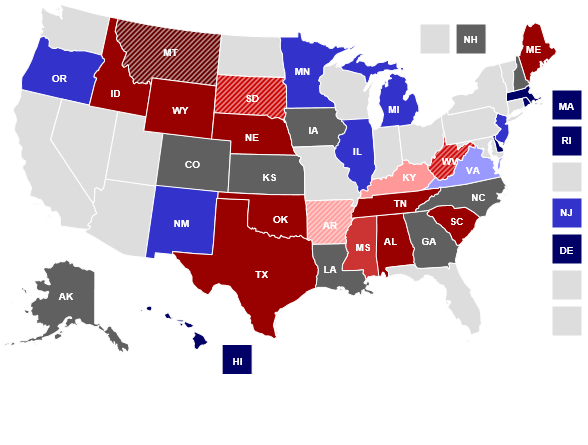
On the eve of this national midterm election polls are continuing to suggest a decided shift in congressional2014_elections_senate_map power. According to Real Clear Politics, current polling indicates 45 Democratic candidates are probable Senate winners, while 47 Republican candidates are positioned to be elected – leaving 8 races considered tossups. If voting plays out as polling suggests – and really, that’s a subject ripe and deep enough for a few hundred theses over the next decade I would think – Republicans only need to win half of those races to secure a 51-seat majority in the Senate.

The Affordable Care Act continues to be unpopular at around 38% of the country having a favorable opinion and 52% having an unfavorable opinion. With Republicans controlling both houses of Congress and their long-standing opposition one would think repealing the ACA would be priority one. But with President Obama’s unequivocal certainty to veto any attempt to repeal the ACA and 60 votes needed for cloture an outright repeal is unlikely. And candidly, a lot of Republicans are not anxious to take away parts of the Act that have proven popular.

So what is likely then. The Senate has never held a symbolical repeal vote, so it will be politically important to Republican Senators they have an opportunity to be on the record as voting for repeal. So we’ll have to endure that circus. Once past the political symbolism I think it is anyone’s guess what’s next. And that’s because it’s anyone’s guess who will ultimately control the soul of the Republican party.

There is the school of thought that a Republican majority in Congress would reflect a referendum on incumbency over frustration with that body’s inability to accomplish anything meaningful. To be sure, it would also be viewed as a referendum on the Administration. But another two years of meaningless symbolic gestures at the President’s expense might not play well for Republicans in 2016, which will be for even bigger stakes. While a more moderate tone from Republicans willing to find common ground with Democrats could lead to modifying and/or repealing the most unpopular aspects of the ACA.

On the other hand, strong-willed elements of the party’s conservative wing could once again seek to hold the Republican Party hostage in the name of being committed to their ideological base. Realizing their only chance of gaining popular support on a national level is to galvanize that ideology beyond current levels of support they don’t have much to lose by risking the ire of those who might view them as obstructionists.

If there were to be some revisions that somehow could be agreed upon by both parties, they would likely need to already have popular appeal – e.g., repeal of the employer mandate provision, repeal of the annual health insurance fee, repeal of the medical device tax – and possibly even repeal, or at least modification of, the individual mandate.

Why are these appealing? Because they lower costs to voters – whether directly or intuitively through the cost of doing business. What is far less attractive are things like repealing individual tax credits and cost-sharing subsidies for health insurance and funding of Medicaid expansion. That leaves a bit of problem for Republicans then, doesn’t it: cutting revenue without cutting expenses while seeking to be fiscally prudent as a primary positioning strategy ahead of the 2016 presidential election.

So how would this be political conundrum be reconciled? Hands, please.

My educated (as in reading the writing on the wall) guess is we will see even more pressure on providers to control costs and system utilization. More emphasis on provider risk sharing. Continued focus on value and tying outcomes to investment. Further support for capitation-based payment models via managed care. Oh, and increased pressure to embrace performance improvement and quality-based systemic approaches that have proven successful in achieving production efficiencies in other industries.

Whatever the outcomes of tomorrow – and however those outcomes manifest in the legislative and regulatory impact on the healthcare industry – all healthcare providers would do well to understand and accept that staying on top of state and federal activities is going to be crucially important to organizational survival.

Cheers,
  ~ Sparky

This Is Not Your Grandma’s Taxi

This Is Not Your Grandma’s Taxi

Having worked with numerous organizations over the years that provide services and care to seniorsDelorean_DMC-12_Time_Machine_in_San_Francisco living in their communities I know that transportation is very often a primary obstacle to expanding and improving those services and care. Whether needed for a doctor’s visit, a rehabilitation appointment, a flu shot, a socialization event, a trip to visit family – it is typically not the distance as much as the inability to coordinate the timing of demand with availability in an efficient manner that creates challenging cost obstacles.

There are organizations across the country that have been effective at tackling this obstacle by leveraging information and communication technology. For example, Senior Transportation Connection serves individuals in Cuyahoga County, Ohio by utilizing mapping and scheduling algorithms (EasyRides©). I had the opportunity to visit their “command center” a few years back and was impressed with how much they are able to do with so little financial support. Truly amazing.

Even so, seniors using STC have to schedule their travel appointments by noon two days prior to the appointed time. It doesn’t take a great deal of imagination to realize there will be many circumstances when the best efforts to plan ahead will fall well short of providing the level of access needed for many seniors still wanting to live independently.

Enter Uber. Jason Oliva writes in yesterday’s Senior Housing News that the San Francisco-based ride service company has just announced it will be expanding its transportation services into San Diego. UberWAV and uberASSIST are ride offerings specifically designed to accommodate elderly individuals living with disabilities.

For those – who until recently included myself – unfamiliar with the Uber concept, the simple genius (yeah, one of those V8 moments I’m afraid) is the development of a smartphone application that connects passengers with vehicles for hire. Not a cab for hire, mind you, but an individual who has signed up and been vetted to provide safe, reliable transportation (yes, I would like to understand that whole process better myself – but that’ not the point of this post).

From a business perspective, the value proposition appears to be the ability to concurrently offer convenience and affordability on the demand side while providing income-earning flexibility and lower barriers to entry on the supply side. As you might imagine, the lower barriers to entry proposition has not played well with taxi and limousine companies – there have actually been protests staged in several countries, including Germany, France and England. I’m sure we’ll get round to it once we get by Halloween.

Now you can just see where this idea is going to eventually cause all sorts of policy issues: free market solutions to public challenges usually do, for better or worse. What are the safety risks? Who is insuring those risks? What happens after the first case of elder abuse is reported?

Having the requisite vehicle apparatus to accommodate disability is one thing – having a driver that can thoughtfully and emotionally navigate through an individual’s confusion and dementia is another. Will seniors be able to use the application in a crisis? Can it/should it be available in cases of emergency? There’s a lot to think about to protect seniors from abuse – intended or not.

On the other hand, if we follow the tried and true path of policymaking we will almost certainly regulate Uber services to the point where a creative solution becomes cost prohibitive. Without market-driven innovation we will never be able to tackle all of the challenges associated with a dramatically aging society.

What do Pub patrons think? Share your thoughts by leaving a comment.

Cheers,
  ~ Sparky

Photo credits:
Delorean DMC-12 Time Machine in San Francisco
CC BY-SA 3.0
Ed g2s – Own work

I Will Never Forget

I Will Never Forget

I_Will_Never_Forget_CoverLast week I shared with Pub patrons the amazing night at the 2014 LeadingAge annual meeting featuring the premier of Glen Campbell: I’ll Be Me. As a follow up to that and to contribute further toward the education and awareness of the challenges associated with caring for individuals afflicted with Alzheimer’s disease and other forms of dementia I wanted to share with you Elaine Pereir’a book, I Will Never Forget.

Elaine tells the story of her mother’s battle with dementia and how it turned a brilliant woman into someone confused, compromised and agitated in its wake. It is a tribute to her mother’s journey – and it was written for everyone facing a similar journey.

Elaine is a retired school occupational therapist who has worked with special needs children. She earned her bachelor’s degree in occupational therapy from Wayne State University and later completed her master’s degree. She can be reached at
elainep@IWillNeverForgetBook.com

Cheers,
  Sparky

New Payment Models’ Impact on Innovation

New Payment Models’ Impact on Innovation

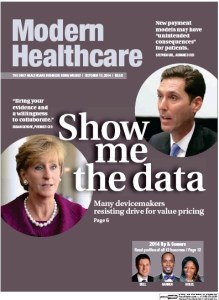
getimageThe backdrop for this week’s feature article in Modern Healthcare by Jaimy Lee and Sabriya Rice is last week’s annual conference of the Advanced Medical Technology Association. Known as AdvaMed 2014, it is the leading MedTech Conference in North America, representing more than 1,000 companies. Commensurate with the event, AdvaMed released a new white paper that expresses concern over the potential impact risk-based payment models could have on provider adoption of emerging medical technologies.

The “Show me the data” headline connotes the growing demand of private insurers, as well as policymakers and governmental agencies, that the efficacy of such technologies be supported with evidence. And while AdvaMed, ”generally supports the movement toward new payment models that encourage providers to reduce costs through greater coordination of care,” its not too thinly veiled concern, of course, is whether and to what extent the demand for data will serve as a tactical smokescreen supporting cost control at the expense of patient care – as well as those companies’ financial success. Regardless of the relative priorities of those two objectives, pressure to control costs under risk-based contracting will certainly affect future provider decision-making impacting the adoption of un (or, at least, under) proven technologies.

I don’t think one has to belie their political persuasion to reasonably understand the pragmatically challenging conflict of this discussion. The overwhelming trends of transparency and evidence-based care in healthcare necessitate that manufacturers make the required investment to understand and be able to articulate their product’s cost/benefit story (i.e., the value proposition). The MH article shares the experience of Medtronic, a medical-device manufacturer whose research uncovered a tangential benefit of being able to reduce hospital readmissions that it could use to enhance market value.

But we also know from experience that data supporting patient benefit often trails substantial initial investment, trial and error and the ability to assess that benefit over years of a patient’s life. In a delivery system that has been able to support waste and largesse the need for patience has been a tolerable frustration. In a system where a major focus of all participants is now cost containment there’s a lot less patience.

The recurring policy challenge, as if there was just one, is in cutting through the individual agendas of industry participants to try and find some sense of balance between cost reduction and what is in the best interest of patients while not artificially stifling the enormous benefits we have enjoyed in this country from medical technology.

In Malcolm Gladwell’s latest jewel, David and Goliath, he profiles the work of Dr. Jay Freireich in the mid-50s through mid-60s. Freirech and his colleague, Dr. Tom Frei, pioneered the treatment of childhood leukemia by first transfusing patients with platelets to stop chronic bleeding. Following that they advanced the then novel approach of chemotherapy to include multiple drugs rather than a single drug.

In both instances, Freireich and Frei didn’t have to contend with whether or not insurers would underwrite the cost of their efforts. Rather, at the time they could not even get the support of their academic and clinical colleagues, so outlandish and absurd were their unorthodox approaches, which often caused great pain and hardship to their young patients. Except that in 1965 they published, “Progress and Perspectives in the Chemotherapy of Acute Leukemia,” in which they described their successful treatment of childhood leukemia. Today the cure rate is greater than 90 percent, and thousands of children’s lives have since been saved.

Is AdvaMed right to warn us against the impact risk-based payment models will have in the name of cost containment? Could the next Freireich & Frei team of innovators be kept from achieving a dramatic life-saving achievement because cost-containment will trump the patience needed to evidence results? Or is AdvaMed understandably overstating the case in doing what it is expected to do: advocate for the members funding that organization’s existence?

Cheers,
  Sparky

Only Innovation Will Reduce Readmissions

Only Innovation Will Reduce Readmissions

Body, Mind, Soul, And Spirit ConceptAs reported on yesterday in Kaiser Health News, over 2,600 US hospitals – the most to date – will have their average Medicare reimbursement rates reduced over the period October 1, 2014 through September 30, 2015, due to the Hospital Readmissions Reduction Program. The overall reduction is projected to realize $428 million in savings to Medicare – i.e., translated as lost revenue to hospitals.

For anyone still unfamiliar with the reductions program, in a nutshell it is an attempt to use public policy to achieve more efficient alignment between patent care requirements and the overall cost of care provided – particularly to the extent costs are driven by care setting. Or, more pragmatically, Medicare does not want to pay the comparatively higher overhead costs associated with acute care settings if a patient’s readmission to that setting could have been avoided.

Of course, there’s the rub that will eventually have to be reconciled if the program is to remain: can we really objectively and often times arbitrarily determine what’s avoidable? The primary reason this is so difficult is because of the myriad environmental considerations that impact patient recovery and sustainable treatment away from the acute care setting. Where someone lives (housing), their neighborhood, their human support network, access to transportation, cognitive state and capacity for engagement, recognition of comorbid considerations such as anxiety and depression – the list goes on.

Hospitals and their clinical teams are taking the readmission program seriously. A three-percent reduction in revenue from your largest source when you are already struggling with narrow margins has that effect. New efforts to forge relationships with post-acute/long-term care providers, patient communication strategies, multi-provider think tanks, post-discharge follow-up programs, transitional care planning, utilization of telehealth and telemonitoring technology, targeted disease intervention – these primarily represent the extension, or repurposing, of core clinical capabilities.

Not to discount the importance of these initiatives, but by and large there is nothing all that innovative here when compared to the fundamental nature of the problem we are trying to solve. And there is a limited ability to address the fundamental challenge driving hospital readmissions: the environmental obstacles shared above. Worse yet, these tactical approaches fail to embrace the holistic reality that is patient treatment and recovery.

That’s where innovation efforts have to be focused: not on keeping someone out of the hospital but on removing the environmental obstacles that drive readmissions as a consequence of undesirable recovery and sustainability. As Toby Cosgrove, President and CEO of the Cleveland Clinic wrote earlier this week, “as my friend Professor Michael Porter of Harvard Business School says, innovation is the only solution to … long term issues faced by American healthcare.”

And it will ultimately be the only solution to lowering hospital readmissions.

Cheers,
  ~ Sparky

QAPI From the Front Lines

QAPI From the Front Lines

One person lifts the word Compliant and others are crushed by non-compliance, as the winner follows This is the PolicyPub’s first post by a contributing author. I have recently written on the upcoming QAPI mandate included in the Affordable Care Act and the impact that will have on nursing homes – particularly those unprepared (which I am coming to realize appears to be the majority).

I am thrilled to have my Artower colleague, Terri Durkin Williams, R.N., L.N.H.A., share her practical experiences with QAPI.

The Nursing Home industry is being challenged to develop quality programs that consistently maintain regulatory compliance. This shift in continuous improvement will require organizations to self-assess their operational performance. In turn, this will move organizations from the established routine of monitoring systems to self-assessments.

The federal government has mandated a Quality Assurance and Performance Improvement QAPI standard under the Affordable Care Act. This mandate was to be established and implemented in nursing facilities by December 31, 2011. As yet, regulations implementing the QAPI program have not been released by CMS.

The purpose of the QAPI program is to develop best practice in providing services and care to nursing home residents. This should be the mission of all health care providers. Waiting for the government to lead us in our business is jeopardizing organization survival both financially and in the delivery of services and care.

QAPI is not a new concept: it has been widely used in healthcare organizations for quite some time. The nuclear power industry has embraced this process to assure quality controls, safety, maintain regulatory requirements, increase efficiency and enhance the reputation of individual power plants. Achieving these goals requires a significant commitment of organizational time and personnel.

Given the tremendous cost pressures and narrowing reimbursement, however, management often judges such commitment as an unaffordable expense. The tendency is to not proceed with an in-depth evaluation of organizational functions. This is too often unfortunate short-sightedness of executive management. It leads to undesired consequences such as, poor care resulting in litigation, staffing turn-over, declining census, fines due to regulatory deficiencies, dissatisfied customers and increase in regulatory over-sight to just mention a few potential outcomes.

A common current practice in quality assurance programs is to monitor a task that is being performed by personnel. The evaluator observes the personnel and uses a check list to determine if the standard being monitored is compliant. The pitfalls of this approach include:

  • Observers not being trained in a manner that results in the consistent application of standards used to perform the evaluation; i.e., the evaluation is based on the observer’s personal biases;
  • Personnel performing to the standard while being observed;
  • Personnel documenting what is required, but not assuring that care was delivered according to the established standard;
  • Monitoring as a snapshot observation; it does not tell the entire story;
  • Organizations using limited information that is gathered in the monitoring process to determine compliancy – this can give a false sense of success and prevent the exploration of best practices
  • Monitoring that  does not guide the organization to the root cause(s) of problems, does not allow for personnel to explain their performance and fails to obtain what knowledge the personnel have of the standard being monitored:

  • limits the beneficial involvement of all personnel in the process;
  • is often viewed by personnel as a punitive measure; and
  • creates a disconnect in communication throughout the entire organization.

Poor preforming organizations tend not to take time to complete a comprehensive assessment of their operational issues and challenges. They may feel that they do not have time for a comprehensive assessment. This causes them to guess at what the problem is and just perpetuates a poor practice.

Example Case
I was recently involved working with an 84-bed nursing home that had seven (7) “immediate jeopardy’s” for a period of six and a half months. Their approach to quality assurance was to have nursing managers spend several hours a day monitoring and documenting problems. But there was no understanding of the root cause(s) of those problems. They received fines from CMS of over a half million dollars. This organization would have benefited from a self-assessment program.

The alternative to this chaos is planning for cultural change that will lead to best practices. The embracement of the self-assessments program exemplifies this and is characterized by the following:

  • Supported by organizational leadership;
  • Involvement of personnel at all levels within the organization to promote professional growth;
  • Effective and efficient communication – a team working together and respecting each other;
  • Focus on evaluating the most important aspects of the people, process, and technology;
  • Comprehensive understanding based upon a collection of observations, record reviews, personnel interviews, benchmarking data, and other ongoing assessment information measured against specific criteria;
  • Identification of performance deficiencies and potential causes, organizational strengths and weaknesses and opportunities for improvement
  • Evaluates performance against established best practices;
  • Provides opportunities to change the culture of the organization;
  • Stabilizes daily operations, by consist expectations, policies and procedures and
  • Establishes a culture whereby organizations control their business activities based on mission and purpose.

Key components of a successful self-assessment program include:

  • Executive management and board leadership’s passion for excellence;
  • Identification of an individual that is supported by leadership as the Team Leader in championing the Art of Quality.
  • Entire self-assessment team educated on the organization’s mission and leadership’s expectations – and they are accountable for their actions;
  • Defined sequence of the self-assessment process;
  • Evidence based standards;
  • Requisite IT support that facilitates the collection of relevant data, analyzes information and provides benchmarking; and
  • An ability to have fun, learn and celebrate successes.

To explore how your organization can implement Artower’s EviQual™ Self-Assessment Program using evidence based practice contact me at twilliams@artoweradvisory.com or 216.244.2923.

  ~ Terri

Culture Change at the Core of QAPI

This past Friday I attended the 2014 Katz Policy Lecture at the Benjamin Rose Institute. Peter Kemper, PhD, Professor Emeritus of Health Policy, Administration and Demography from Pennsylvania State University gave the lecture on Expanding Culture Change to All Nursing Homes: Challenges and Policy Approaches.

Professor Kemper acknowledged early on what is often the opening salvo of critics of culture change – that defining exactly what it is can be a formidable challenge. In fact, as he noted, it may be preferable to think of culture change as a movement instead of a model. This perception would be consistent with the concept of continuous quality improvement where it is recognized that while operational perfection is inherently unachievable, evidence shows its pursuit drives measurably better outcomes.

Cutting through the theory and research, at its core culture change is the ability to create an organizational environment in which individuals are empowered, trusted and valued: and this must be true for both patients and the workforce caring for them. What does this look like? Well, in listening to the lecture I found that we need look no further than the five elements of Quality Assessment Performance Improvement (QAPI).

Element 1: Design and Scope: Culture change can only take place if there is a shared commitment to be cognizant and aware of how each individual’s role and responsibilities support achievement of the organization’s future state vision. To accomplish this there must be an understanding and pragmatic recognition that the approach needs to be comprehensive, inclusive and constantly evolving.

Element 2: Governance and Leadership: It is the organizational leadership’s primary responsibility to create the environment by owning (without controlling) the design and scope process, while the role of governance is to ensure sustainability and accountability of that environment once created.

Element 3: Feedback, Data Systems & Monitoring: The old adage of you can’t manage what you can’t measure, however incomplete in its ability to capture the full essence of organizational behavior, nonetheless is the primary means of incenting desired behavior while discouraging unwanted behavior (i.e., accountability). This must be a fundamental element of culture change, particularly from the standpoint of sustainability.

Element 4: Performance Improvement Projects: The key concepts attributable to culture change here are prioritization and ability to impact. The important nuance that many PA/LTC organizations have difficulty understanding is that PIPs don’t have to be directed retrospectively. They can (and should) be borne out of a comprehensive design and scope process (i.e., Element 1). This is a key element of intersection between culture change and QAPI programming that must be embraced and understood.

Element 5: Systematic Analysis and Systemic Action: Socrates noted that, “the unexamined life is not worth living.” I contend that an organization committed to culture change will continuously assess and examine whether and how well it is able to achieve its vision while fulfilling its mission and always reflecting its core values. This brings us full circle to the concept of continuous quality improvement noted at the beginning of this post.

As Professor Kemper also noted during his lecture, there is nothing necessarily innovative or revolutionary about culture change in PA/LTC. My observation is that it is really a matter of borrowing – or adopting – proven best practices of organizational behavior from other industries and research that dates back to the early 1900s. But going from theory and research to realized benefit takes the type of leadership that isn’t as easy to import. That’s where a lot more work needs to be done before either culture change or QAPI can achieve meaningful and lasting improvement in patient outcomes and life enrichment of the individuals served.

Cheers,
  Sparky


Picture Credit: Provider Magazine

QAPI: A Steep Learning Curve for Many

Compliance Conceptual MeterI am becoming increasingly concerned that many, if not most, post-acute/long-term care organizations are poorly prepared to embrace the requirements of the looming Quality Assessment Performance Improvement (QAPI) reporting requirements mandated by the Affordable Care Act. I base that conviction on how much I have learned over the past few years working with my colleague, Nathan Ives, of Strategy Driven Enterprises, LLC.

A graduate of the United States Naval Academy, for over two decades Nathan has been immersed in the world of quality assessment, performance improvement and regulatory compliance as each has applied to the nuclear power industry. He has held several influential positions at the Institute of Nuclear Power Operations (INPO) and has led teams of nuclear operations professionals in the performance evaluation of over 24 nuclear electric generating stations from 20 utilities in the United States, Canada, and Japan. He also led the nuclear industry’s effort to redefine performance standards in the areas of organizational alignment, managerial decision-making, plant operations, and risk management.

For the past two years, Nathan has been working with my Artower colleague, Terri Williams, RN, on developing EviQual™, a turnkey regulatory compliance solution that PA/LTC organizations can use to create a QAPI program. Terri has nearly 30 years of experience as a practitioner, educator and advocate for quality improvement and patient safety at PA/LTC facilities. Now, as a I have neither an operational engineering nor clinical background, for me it has been a fascinating learning experience. And what I have learned primarily is that QAPI – as understood from how it has been applied in other industries – is an entirely different approach to outcome quality and patient safety than what most PA/LTC organizations are currently familiar with.

Whereas historically those organizations have focused a great deal of attention on observing, recording and diagnosing the cause(s) of adverse events, the whole point of a quality assessment program is to proactively diagnose existing practices, policies and performance to create an environment in which such events don’t happen in the first place. It is a paradigm shift in thinking and approach that for most organizations must be accompanied by changes in organizational culture.

That’s why in creating EviQual™ we have sought to leverage the already existing knowledgebase of what has been proven effective in improving quality and safety in an industry that has many parallels with healthcare. In fact, Nathan and I collaborated on a white paper  some time ago on the applicability of lessons learned in the nuclear power industry to aligning healthcare organizations via quality and performance improvement.

The Centers for Medicare and Medicaid Services has made available QAPI at a Glance, a step-by-step guide focusing on 12 core elements ranging from organizational sponsorship and leadership to tactical  program implementation. A very well written accompaniment to that guide was just recently completed as a series of articles for Long-Term Care Magazine by Nell Griffin, LPN, EdM. Both are wonderful resources if you are new to understanding QAPI and the important ramifications it will have on PA/LTC organizations.

The first step in the 12-step process for implementing a QAPI program focuses on leadership, responsibility and accountability. What this requires is the active and committed sponsorship of the QAPI process by senior executives and board members. So when I hear leadership teams at PA/LTC organizations say they are confident their clinical teams are proactively addressing the QAPI requirements, I can’t help but fear those organizations have already stumbled out of the gate.

Cheers,
  ~ Sparky

.

Moving Away From Sick Care

There is a saying that goes, “America doesn’t have a healthcare system – we have a sick-care system.” I don’t know whether that quote is attributable to an individual or not, but the connotation is that what for decades has served as a healthcare delivery system belies the underlying premise that the individuals benefitting from that system’s value proposition are, indeed, healthy.

Of course, they are not – at least at the time service is required.  They are sick, ill or afflicted by a myriad of chronic diseases and conditions. Whatever we want to call it, a system that addresses the needs of these individuals is critically important. But the study in ironic contrast serves to raise awareness of the need to address population health as the best hope of reigning in the unabated march of healthcare’s gobbling up the nation’s GDP.

Last week a new Health Policy Brief, The Relative Contribution of Multiple Determinants of Health, was released by Health Affairs and the Robert Wood Johnson Foundation that looks at factors and considerations impacting individual and population health. These are commonly referred to as health determinants and can be summarized into five major categories: genetics, behavior, social circumstances, environmental and physical influences and medical care.

Researching and understanding how specific factors and considerations within these categories impact individual and population health is very challenging because of complex, interdependent, bidirectional relationships – and because the timeframe over which meaningful measurement must take place can often be decades. But if the US delivery system is to make a paradigm shift away from having a sick care system, efforts must continue to understand whether and how health policy interventions and choices, as well as the efficient use of limited resources, can achieve better outcomes.

This, in turn, requires the adoption of a more holistic understanding of health: the roles social and environmental (i.e., nonclinical) determinants play in impacting individual health. Human behavior, for example – a primary concern in understanding poor health outcomes – must be understood and assessed, “according to multiple dimensions and at various points of intervention.”

Despite the challenges, progress continues on understanding the role nonclinical determinants play in individual and population health outcomes. The continued advancements in Big Data should accelerate these efforts. The policy brief referenced above provides a nice overview of these efforts with resources that should be noted by healthcare providers wanting to better understand how their competitors are seeking to become strategically aligned with population health management.

There are currently a lot of major healthcare providers touting in the press their foray into population health, as if the opportunity for impact is ripe for harvesting. But having recently become more educated and aware of the myriad issues and complexity of population health, I do have to wonder if their strategies are too narrowly focused on how to creatively redeploy existing assets and resources – rather than making a candid and honest assessment whether either can be productively leveraged in the context of a holistic approach to healthcare.

Cheers,
  Sparky