Healthcare & IT: Oil & Water?

Healthcare & IT: Oil & Water?

I don’t think it has to be that way, but the history of IT adoption and implementation in healthcare might lead many to believe otherwise. True, there have been major advancements just over the past decade, but from a public policy perspective, have federal policy initiatives helped – or hindered – that progression?

I think most everyone would agree that information technology holds great promise in improving the value of healthcare delivery. And by greater value I mean assisting caregivers and clinicians produce better outcomes at lower cost. Except that in many instances it’s not working that way.

Practical Experience
Courtesy of the healthcare policy-oriented site,
KevinMD, I recently came across a blog post by Dr, Christine Sinsky that made me decide it might be a good time to bring this topic up again with you. Dr. Sinsky’s blog post, Hazards of Poorly Designed Decision Support, is an anecdotal yet nonetheless compelling reality of IT utilization in healthcare. The decision support system in question is Trinity Health’s mandatory DVT Advisor.

DVT stands for deep venous thrombosis, which in laymen terms means a blood clot that that forms in a vein deep inside a part of the body. DVTs are most common in adults over age 60 but can occur at any age. If the clot breaks off into the bloodstream, it is called an embolism, which can get stuck in the brain, lungs, heart, or other area, leading to life threatening situations.

DVT Advisor was implemented in response to Meaningful Use requirements. You can read Dr. Sinsky’s post if you would like to understand the practical frustrations she found in using it, but for the purpose of this post I will summarize the key points.

Shortcomings
From her perspective (my interpretation now) there are two key areas of the system that are counterintuitive to facilitating value creation as I describe above: unnecessary input requirements and decision tree logic rigidity that was unable to capture and reflect the patient’s situation (i.e., usability challenges). In essence, the system created more work – and more importantly, introduced a new level of potential risk – than would not have existed without its use. Now that, Pub patrons, is what’s known in laymen terms as, “stupid.”

In the interest of fairness and disclosure I want to note that Dr. Sinsky was complimentary of certain elements of the system; e.g., “the information in the DVT Advisor can be a useful reference if a physician is uncertain about anti-coagulation, but its intrusive and insistent characteristics are based on hope and belief, rather than evidence.”

Policy Issue
And so here’s the policy issue: you have an IT decision support tool that has the potential to add value but for the fact that its design has actually lowered it. Now,
I have been an ardent proponent of supporting advancements in HIT as a primary means of improving productivity and efficiency – and thus lowering care delivery costs. I have been less enthusiastic about the top-down approach of HIT policy the federal government has employed to advance those efforts. I have also believed, however, there is the need for an active role of government in helping advance health IT adoption. The what and the how of that role is less certain today.

So for me, Dr. Sinsky’s post is not the needle-in-the-haystack that generated an intellectual epiphany on my part regarding the effectiveness of HIT policy efforts. There is more than enough research and literature supporting logical skepticism for the open-minded to consider. Rather it was more of the straw within the haystack that broke the camel’s back. I am looking for some pub patrons that understand this subject-matter much better than me to weigh in here.

There are some of the most brilliant minds in the world working in HIT – in the clinical and nonclinical arenas – but I sometimes wonder if they can’t get out of their own way to understand the pragmatic nature of value creation. And I wonder if federal policy and governmental agencies haven’t been just willing abettors counting more on hope than evidence as Dr. Sinsky points out.

Please, prove me wrong – show me the evidence where HIT public policy has been more effective than not.

Cheers,
  Sparky

P.S. Please click on the hyperlink above associated with Dr. Sinsky’s name. This will take you to her website where there is a wealth of information on HIT based upon her and her husband’s professional contributions.


Challenges of Episodic Payment Bundling

Challenges of Episodic Payment Bundling

Last week the New England Journal of Medicine included this Perspective: Post-Acute Care Reform—Beyond the ACA by D. Clay Ackerly, M.D. and David C. Grabowski, Ph.D. The article describes the case of what I believe is a hypothetical patient: Mrs. T., an 88-year-old woman who was admitted to the hospital following a trip to the emergency room.

You can read the article to get the specifics of her case. The thrust of what is shared by the authors has to do with how existing Medicare payment methodologies and regulations impact clinical decision making in ways that are not necessarily in the patient’s best interest. And how payment bundling—particularly across acute and post-acute/long-term care providers—faces challenges that simply aligning financial incentives of those provider types will not adequately address.

In theory, the core precept of episodic payment bundling is that if otherwise historically disparate healthcare providers treating the same patient can be financially incentivized to better coordinate care for that patient, the costs attributable to inefficiencies, redundancies, productivity, etc. will be reduced.

Of course, underscoring this precept is the notion that human beings acting in their self interests (i.e., in pursuit of income and wealth ~ Adam Smith’s Invisible Hand) will create valuable external benefits. The counter to this belief could be found in Garret Hardin’s Tragedy of the Commons, which argues that those self interests can lead to depleting common resources to the disadvantage of wider interests – e.g., the community or society.

Economic theory aside, what the authors argue for is additional governmental intervention to remove obstacles they cite as impeding the benefits that payment bundling might otherwise achieve. These include addressing regulations impeding patient transfers between settings (e.g., the 3-day rule); research into various care delivery models that facilitate more effective care transitioning – particularly those elements outside of the clinical setting; and third, increased investment into comparative effectiveness research to help providers better determine appropriate post-acute/long-term care setting for their patients.

So here’s the irony: though many critics of the Affordable Care Act either disbelieve or refuse to accept that it was in many ways an attempt to thwart or at least delay the movement toward a national healthcare system, concepts like payment bundling, insurance exchanges and capitation are theoretically dependent upon market-based solutions. Provide the financial incentive and just watch market-driven forces create valuable solutions.

Now we are being advised in this article that’s not enough. We have to also regulate away the challenges and obstacles that market ingenuity was supposed to overcome. Sorry – but isn’t that somewhat counterintuitive?

Here’s the challenge. We recognize that individuals’ productivity – in terms of being able to create value – is closely correlated with their desire to pursue individual needs and wants (back to basic Economics). And so if we want to maximize value it follows that we need to maximize individual incentive. In a free market that is most effectively accomplished by allowing individuals to make their own choices, unfettered from governmental interference except for ensuring fairness and safety.

What we are trying to do in healthcare—with initiatives such as ACOs—is create hybrid free market models that leverage the value production ability of individuals while at the same time intentionally and unintentionally interfering with their ability to make unfettered choices. So if healthcare shared common characteristics with other industries, it would be easy to argue that government should just get the hell out of the way.

But here’s the rub. Government is already so deeply entrenched in our healthcare delivery system – at a time where demand is just beginning to grow exponentially – that I fear any serious effort to move backward toward market-based delivery would be like throwing a track switch on a runaway train. And beyond that I remain unconvinced that healthcare is not uniquely different than other industries. Thus we plod along.

What do you think?

Cheers,
  Sparky

Healthcare 2014: The Untrends List

One week into the new year, and here I am already probably tearing at the limits of content relevancy, thinking about how to write something meaningful on what to look for in 2014. What are the emerging industry trends and drivers that healthcare executives need to understand and reflect in their 2014 strategic planning? What’s the competitive landscape going to look like? How will diverging synergies of clinical partnerships impact silo management tendencies? How many overused business school concepts can be stuffed into a blog post?

To be candid, I really wanted to write something here that was keen on unique insights and observations. That had a lofty air containing pearls of wisdom. But the more I thought about what to write the more daunting became the effort of where to start, what to include and how to organize my thoughts without losing you to confusion and boredom in the first paragraph.

And being confused myself under the weight of my inability to organize that thinking it dawned upon me that I was tripping over the most common intellectual obstacle: failure to accept that too often our desire to embrace the complex hides our fear of accepting the wisdom of simplicity.  And that reminded me of the scene below between Billy Crystal and Jack Palance in City Slickers. It epitomizes the challenge we have in accepting simplicity.

Curly’s One Thing

So what’s the ONE THING that healthcare providers need to focus on in 2014? Easy answer: the same thing they needed to focus on in 2013. And 2005. And 1919. VALUE. But just as our understanding of life can be both simple and difficult – so too can learning to strategically position a healthcare organization around value.

The concept of providing value is ancient.  Yet the ability to create, deliver and capture value is an increasingly important – and contextual – competitive advantage when resources become constrained at the same time demand is accelerating. Value-based pricing and cost reimbursement models are only a part of the value-driven healthcare paradigm. It’s the small top part of the value delivery pyramid (or perhaps iceberg is a more fitting analogy).

Critically important to understand is what the patient values. And even more important is accepting the processes that patients use for determining and comparing relative value does not easily lend itself to linear thinking or evidence-based protocols. Similarly, the individuals who create and bring value to patients cannot be made to fit into standardized care delivery machines. And understanding how they assess and compare relative value is every bit as important in creating a competitively superior healthcare offering.

Healthcare providers are increasingly being asked to share in the risk of care delivery economics. I know that must sound ironically distasteful to many, since they have already for centuries borne the ultimate risk of patient outcomes. But on the whole, I believe it’s an oddity of our healthcare financing system – not a perverse entrapment designed to reallocate resources away from production – that seeks to align the incentives of multiple participants around value.

If, however, that understanding is ultimately manifested in just measuring and promoting value – without creating and delivering value – value-driven pricing and reimbursement models will necessarily fail, whether that’s payment bundling, ACOs or medical homes. But – those organizations that learn to create and deliver value by strategically positioning themselves in lieu of the industry migration toward integrated care delivery will survive whether those new models succeed or not.

So my list of trends and drivers for 2014 is simple: value, value & value.

Cheers,
  Sparky

Mandate Delay: Chuckhole or Sinkhole?

Mandate Delay: Chuckhole or Sinkhole?

AARepublicans have failed to thwart it. The Supreme Court refused to kill it. A majority of Americans decided not to abandon it through a national referendum election. And it would appear Nancy Pelosi has still not taken the time to find out what’s in it.

Earlier today when asked whether there could be, “any virtue” in last week’s announcement that businesses with 50 or more full-time employees will not have to begin complying with ACA reporting requirements until 2015 (a year delay), she responded, “no – absolutely not.  I don’t think it’s virtuous at all.  In fact, the point is, is that the mandate was not delayed.  Certain reporting by businesses that could be perceived as onerous — that reporting requirement was delayed, partially to review how it would work and how it could be better. It was not a delay of the mandate for the businesses, and there shouldn’t be a delay of the mandate for individuals.”

Mind you now businesses are being exempted from the codified penalty associated with failing to report how many full-time employees they have, the number of hours they work and how much those individuals have to pay for company-sponsored health insurance coverage. While employers are, “encouraged” to provide affordable insurance for their workers in 2014 there will be no penalty if they do not. That’s not a delay? Who is her policy advisor anyway? Dennis Kucinich?

Aside from the side show of political haberdashery that is by no means the singular purview of Ms. Pelosi nor the Democratic party there are some potentially critical ramifications of the Administration’s decision to delay implementation. On the one hand, because a majority of businesses with 50 or more employees already offer healthcare benefits (e.g., 94% of businesses with 50-199 workers offer coverage while only 1% of US workers are employed by companies with 50 or more employees that do not offer health benefits) the delay’s impact on coverage expansion is not going to be significant.

On the other hand, the delay is nothing less than a giftwrapped political grenade in the hands of the GOP and every interest group in opposition to any element of the ACA. Now called into question will be the workability of not only the employer mandate but other elements of the Act, such as the all-important Individual Mandate, Insurance Exchanges, Medicaid expansion and on and on. If critics are right that the ACA is a bureaucratic house of cards built on a shaky table, well then this delay could be viewed as removing the matchbook from under the table’s leg.

There is also the pragmatic side of this discussion that argues it is better to delay and use that time wisely to ensure implementation is as effective and economical as possible. But it would seem to me the implementation of the IM will be more complicated than the EM because of numbers and nature: there are a lot more individuals than businesses, and by their very nature many (most?) of those individuals don’t have the inherent technical wherewithal to collect and provide the information that will be required for the IM. Delaying implementation of the Individual Mandate would, I believe, be a death knell for the ACA, and I think most Democrats (and, of course, Republicans) share that view now.

It may be a monumental task for many Democrats next summer having one foot on the campaign trail and one finger in the Capital Hill dike that is holding back a full repeal of the Affordable Care Act. If they are not already in place, the Administration had better abandon all hope of allowing partisanship to influence resource decisions. Not getting the right people in the right place to withstand the oncoming attempts to sacrificially slaughter the IM and exchanges before they even get started will be a political nightmare for the Democratic party that may take several decades to overcome.

Cheers,
  Sparky

A Pub Celebration!

FireworksI completely missed the One Year Anniversary of Sparky’s Policy Pub, which was last Tuesday (business is good, and nobody’s complaining). In the past year I contributed 70 posts that generated  roughly 3,600 views. Whether that’s above, below or right about average I have no idea. But I have had  a lot of fun writing each and every post, which was my goal to begin.
And it has been fascinating to follow the blog stat’s. My number one post continues to be Death Panels Just Won’t Die, which is hit upon most often by folks searching for information on whether knee replacements will be rationed under the Affordable Care Act. It’s for that very reason that post is also my favorite, as I tried very hard in it to combat the misinformation that exists about the Act and how that misinformation has been used to scare our most vulnerable members of society.

So to anyone and everyone who has taken the time to stop by the Pub and read my posts, I want to sincerely thank you for your time and interest. While I find great enjoyment in just having a reason to write, the recognition that comes from knowing someone else finds what I write worth their time to read is very special and very meaningful to me.

I have learned a lot on how to create content that is valuable, interesting and entertaining. I still have a lot to learn, and I am anxious to see where the year ahead will take me – and the Policy Pub.

See you in the Pub!!
  ~ Sparky

Why Can’t We Be Friends?

Why Can’t We Be Friends?

Partisanship is as ingrained into the political fabric of this country as are the imported core ideologies from whence it sprang. The history of our domestic partisanship can be traced to the days of George Washington’s presidency with the establishment of the Federalist Party (led by Alexander Hamilton – being in favor of a strong federal government) and the Jeffersonian Republicans, which under Thomas Jefferson’s leadership advocated for strong state governments.

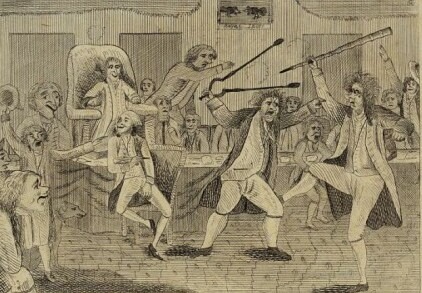
And our history is replete with examples where the individual and collective passions of partisanship have led to bitter conflict, even being manifested in physical assaults on the floors of both houses of Congress.

Shown below is a cartoon depicting a fight in the House of Representatives between Republican Matthew Lyon and Federalist Roger Griswold as depicted in this 1798 engraving. Lyon was the first member of Congress to have an ethics violation charged filed against him when he was accused of “gross indecency” for spitting in Griswold’s face (Griswold had called Lyon a scoundrel, considered profanity at the time).qAnd in 1856, at the heyday of debate over slavery, South Carolina Senator Preston Brooks – deeply agitated at what he considered Massachusetts Senator Charles Sumner’s libelous characterization of Brooks three days earlier in his infamous, “Crime Against Kansas” speech (at which Brooks was not present to protest) – used a metal cane to pummel Sumner, who had to be carried off the Senate floor.
So perhaps, in retrospect, the challenges of partisan politics standing in the way of addressing the nation’s fiscal crisis need to be taken in context. Or do they?

This morning, the Bipartisan Policy Center hosted a town hall meeting facilitated by USA Today’s Washington Bureau Chief Susan Page at the Ronald Reagan Presidential Foundation and Library to launch the Commission on Political Reform. Beginning today, the 30-member commission will be holding forums across the country in the hope of engaging a body politic unwittingly caught up in the maelstrom of political polarization that has been exacerbated and capitalized upon by a Media that serves a profit motive first and civic responsibilities somewhere south of fifth.

Take this, for example. In advance of the new Commission’s launch USA Today recently conducted a clever – albeit devious – poll in which it surveyed 1,000 individuals who were asked to assess two education polices: the first plan would reduce class sizes and make sure schools teach the basics; the second plan would increase teacher pay while making it easier to remove underperforming teachers.

Half of the respondents were told the first plan was a Democratic plan and the second a Republican plan. For the other half of respondents, the labels were reversed. In both instances, respondents overwhelmingly (by a margin of 3 to 1) favored the plan that was associated with their party affiliation. In fact, both sets of respondents were inclined to describe their support as being “strongly” in favor, regardless of which policy was represented.

The BPC’s President, Jason Grumet, in introducing this morning’s town hall panel was deliberate in noting the Commission’s purpose is not to create Kumbaya symmetry wherein political discourse becomes an effort to go along in order to get along. To the contrary, robust debate is needed now more than ever – because the complexity and urgency of the challenges facing our nation demand it.

But today, intelligent, productive discourse and debate is buried in sound bite rhetoric designed to be easily digested by a society in transit, always seeking first to be entertained – and then thoughtful and concerned. Along with that the tribal instincts of our modern social conscience have made the concept of political compromise tantamount to failure.  Since today’s town hall meeting was held at the Reagan Library, I thought it would be fitting to end this post with a quote from President Reagan’s autobiography.

When I began entering into the give and take of legislative bargaining in Sacramento a lot of the most radical conservatives who had supported me during the election didn’t like it.  ‘Compromise’ was a dirty word to them and they wouldn’t face the fact that we couldn’t get all of what we wanted today. They wanted all or nothing and they wanted it all at once. If you don’t get it all, some said, don’t take anything. I’d learned while negotiating union contracts that you seldom got everything you asked for. And I agreed with FDR, who said in 1933: ‘I have no expectations of making a hit every time I come to bat. What I seek is the highest possible batting average.’ If you got seventy-five or eighty percent of what you were asking for, I say, you take it and fight for the rest later, and that’s what I told these radical conservatives who never got used to it.”

Cheers,
  Sparky

Shades of Grey

Charlie Ornstein is a senior reporter at ProPublica and board president of the Association of Health Care Journalists. More importantly, he is the son of Harriet Ornstein, who passed away peacefully on January 18th of this year following a short stay in hospital. Last week, Charlie published an article relating his experience – How Mom’s Death Changed My Thinking About End-of-Life Care.

Reading Charlie’s article reminded me of the insights of Dr. John Henning Schumann, which I shared in my post, The Politics of Dying in America. Charlie’s experience is no different than that of hundreds of thousands of families every year. His perspective, however, is uniquely different because he is now in the unfortunate camp of having looked at end-of-life care from both an objective and deeply subjective vantage.

From a public policy perspective, the vulnerabilities of the American healthcare dragon are so easy to identify that you have to marvel at our inability to effectively exploit them. As Charlie points out in his article, about one-fourth of all Medicare expenditures are made during the last year of a beneficiary’s life. We are paying millions and millions of dollars to buy a few extra days. Doesn’t seem objectively reasonable does it?

What would you pay for one more day? Seeing as the day after one more day the collection agencies wouldn’t be able to reach me, I guess I’d pay whatever my credit would allow. That might get me through Good Morning America. On the other hand, my dad always told me that a noble goal was to leave the world indebted to no one while being the poorest soul in the cemetery. So I got that going for me . . .

Without any intention of being disrespectful to the cherished memory of Mrs. Ornstein, I make light of a scary and depressing topic simply because there isn’t much else to do with it that seems logical. And that’s where very often rational discussions of healthcare public policy breakdown: because one person’s calm, objective logic is another person’s emotional reality. I think this is at least partially what Charlie was getting at in his article.

The elasticity of demand for medical care is one of the most capricious concepts we face in analyzing and assessing healthcare public policy. What I would pay to stay alive another day is necessarily going to be different than what I would pay to keep someone I have never met alive. But the reality is that through public healthcare programs supported by taxation (e.g., Medicare and Medicaid) I do help pay to keep someone alive another hour, day – or hopefully, much longer. Fortunately, I’m not directly involved in that decision making because I cannot imagine what it would be like if I had to choose how my tax contributions should be used – or not – on a case-by-case basis.

The point of all this is while some folks involved in healthcare policy debate would have us believe the world is black and white – with clearly delineated focal points for determining what’s right and what’s wrong – it obviously is not. The real world is a thousand shades of grey between black and white and nowhere is that more evident than when the topic is end-of-life care.

Cheers,
  Sparky


The Political Realities of Sequestration

The Political Realities of Sequestration

imageNow be honest, before last summer had you ever heard the term, sequestration? Though I’m sure I did, I can’t recall when, and I am quite certain I wouldn’t have known the correct Jeopardy question, “What is the term used to describe the legal confiscation and possession of a defendant’s property in lieu of a judgment or court order?” And that’s not even the popular meaning now embedded into our political lexicon.

I have come to understand that Congress’ use of that term dates back to the 1985 Gramm-Rudman-Hollings Balanced Budget and Emergency Deficit Control Act in which it was used as a means of reforming Congressional voting procedures and intended to raise that body’s consciousness that budgeting should be a process of allocation from funds available – rather than an exercise in arithmetic reflecting the outcome of decentralized appropriations (insert favorite form of sardonic humor here).

The idea was that if the combined totals of appropriation bills passed separately by Congress resulted in spending in excess of the limits agreed to by Congress in the annual Budget Resolution, and then if Congress could not agree on ways to reduce that spending (or did not pass a higher Budget Resolution), then there would be an automatic reduction in spending: the aforementioned sequestration.  For me (and I’m sure many of you), this is a rather easy concept to understand because that’s how sequestration works in our house when our appropriations exceed our funding: we often call it, “cancelling our dinner reservation for Saturday evening.”

Back in fantasyland, however, the automatic reduction was to be sequestered by the Treasury and not disbursed as originally appropriated by Congress. In theory, the application of the sequestration is to be regarded pro rata across all agencies, though Congress has typically exempted certain programs such as Social Security and Defense.  The practical result has been that agencies not exempt would experience a disproportionate share of the spending reductions in order to achieve the total sequestration amount mandated.

As retired Senator, Phil Gramm, noted, “it was never the objective … to trigger the sequester; the objective was to have the threat of the sequester force compromise and action.”  Well, as we’ve seen, there is one thing that simply cannot be forced in Washington right now, and that is compromise. The reason for this is the stark contrast in political realities currently characterizing the two major parties.

The Obama Administration believes it won an electoral mandate to advance the country further in the direction of European style Social Democracy (different than Socialism, but closer than many in this country probably realize). And as Bob Woodward recently found out, they are taking a Machiavellian approach to whatever – and whoever – stands in their way. Woodward has lifted the curtain on the Administration, and he has garnered the attention and concern of a lot of folks, life myself, who have generally been supportive of it. And though I very much doubt it was his intention – or concern – he has created a strategic political opportunity for Republicans.

Unfortunately for their party, however, the Republicans are still wandering aimlessly in the sociopolitical dessert of the late-middle 20th Century, looking for the ghost of Ronald Reagan – or any ideological mantra that could garner greater than 50% support of their tattered leadership. In addition, because of the tremendous expense involved in campaigning in an era of modern media and super PAC’s (even in fending off same-party candidates in primaries), having party power of the House of Representatives is like having a gun with one bullet.  The party in power now gets one shot in a Congressional session to make a political impact.

So what we have is not a game of Chicken, where we wait to see which side blinks first.  We have a legitimate ideological stalemate that is being advanced and dominated by the promotion of minority interests holding sway over the respective parties. I say this because according to opinion polls I’ve seen, a significant majority of this country is in favor of raising taxes in order to pay down debt. What that majority is not in favor of is raising taxes to expand entitlements (there is also significant support for raising taxes and reducing entitlements).

The Administration wants to raise taxes to protect and expand the entitlements that are a critical component of their social agenda, while the Republicans want to reduce entitlements without raising revenue (taxes) so as not to alienate their primary campaign funding sources. The sad irony here is not that elected officials from both parties are acting selfishly in their political self-interests. That we’ve come to expect.  The sad irony is the perceived belief that placating minority interests is in their political self-interests more so than acting in harmony with the majority. Now, why is that?

Cheers,
  Sparky

It’s the Culture, Stupid

This post’s title is what I reminded myself of when I read the recent interview Megan McArdle did with Delos (“Toby”) Cosgrove, CEO of the Cleveland Clinic.  In that article, Can the Cleveland Clinic Save American Health Care? Dr. Cosgrove shares and explains several of the core elements behind the Clinic’s success. I was able to identify two concepts discussed by Dr. Cosgrove that I believe are more important to redefining healthcare in the United States than anything else: alignment of incentives and change management.  Both of these concepts are, in turn, major pillars of organizational culture.

And both are concepts, which transcend the argument that comparisons to organizations like the Cleveland Clinic, the Mayo Clinic, MD Anderson Cancer Center, Memorial Sloan Kettering, Johns Hopkins, et al) are often misguided and counterproductive because of the unique positioning and market advantages those organizations hold.

As Ms. McArdle writes in her article,

”Great institutional cultures can accomplish great things.  But in some ways, that’s a problem for the rest of us. It’s natural to want to emulate the achievements of [the] Cleveland Clinic in our policies. But you can’t make a culture out of rules. Culture is an organic outgrowth of an organization’s history, it’s people, its successes and failures. It cannot be ordered from the top, or nurtured by simply altering the financial incentives. Cosgrove speaks of maintaining the institution’s culture in much the way that he talks of maintaining their electronic health records system: a constant process of checking in, re-evaluating, and upgrading.”

But Cosgrove also believes the Clinic’s success can be replicated.  In the article he states that, “yes, other people can do it. One of the things that is beginning to drive this is the patient satisfaction scores that is now becoming part of the pay for hospitals ….” but “both the incentives and the culture matter. They’re inexorably tied.”

Creating a culture that instills and motivates behavior, which reflects incentives tied to desired outcomes – whether those are measured in terms of access, cost or quality and safety – is a difficult challenge that really does not get substantially easier or harder in relation to the size of an organization.  This is because – as my friend and colleague, Craig Anderson (National Director of Healthcare at Dixon Hughes Goodman) is fond of saying – “organizations don’t, never have and never will change – people change, one person at a time.”

And individual change is very hard for all of us.  It means being even more uncomfortable in a world of constant uncertainty.  It means not having the level of control you mistakenly thought you had in the first place.  It means letting go of some very deep-seated beliefs on how your environment should be ordered, arranged and understood.

To create the kind of culture that has been successful at the Cleveland Clinic requires an artful infiltration of the organization’s psyche. Careful attention must be given to long-standing relationships and patterns of behavior.  It is quite easy to do more damage than good. But if done right, the payoff can be a remarkable transformation from a healthcare organization inexorably floundering in reaction to its environment – to an organization that is emulated for proactively achieving great success, like the Cleveland Clinic.

Cheers,
  Sparky

Paging Dr. Watson . . .

Watson, the IBM supercomputer, generated world interest in 2011 when it competed on Jeopardy against former champions of the famous TV game show and won the first prize reward of $1 million.  With access to 200 million pages of structured and unstructured content consuming four terabytes of disk storage, Watson performed without having access to the Internet.  Ever since IBM’s Big Blue beat Gary Kasparov in 1997 IBM has doubled down on its passion for developing technology that seeks to mirror the capabilities of the human mind.

Now that passion is taking Watson into the hospital and physician office. A February 11, 2013 article in Wired Magazine UK, IBM’s Watson is better at diagnosing cancer than human doctors, describes how IBM is partnering with Memorial Sloan Kettering Cancer Center in New York and Wellpoint to make Watson available (i.e., for a fee) to any hospital or clinic seeking its input on oncology cases, including proposed treatment protocols that seek to minimize cost.

The big advantage Watson has over human doctors is its ability to absorb and analyze enormous quantities of data – and then make that knowledgebase more accessible and more affordable.  As example, according to Sloan-Kettering, only 20% of the knowledge doctors use in diagnosing patients relies on trial-based evidence.  But it would take at least 160 hours of reading a week to keep pace with all of the medical knowledge being published – and that doesn’t include the time it takes to determine how to apply that knowledge in practice. Watson’s successful diagnosis rate for lung cancer is 90 percent, compared to 50 percent for human doctors.

This subject-matter reminds me of Malcolm Gladwell’s book, Blink, in which he tackles the subject of rapid cognition: how the human mind processes environmental stimuli and compares, contrasts and analyzes that stimuli against the billions of elements of data that comprise individual experiences comprising our conscious and unconscious memories.  Watson’s ability to replicate that capability is still a long way off.  But the progress already made is fascinating.

While fascinating, practical application of technological advancements in healthcare are often challenged by skepticism. How much of that challenge is created by the natural human resistance to change, how much results from not understanding the new technology – and how much is based upon previous experiences that demonstrate the risks of adopting technology before it is fully proven – is hard to know.

A lot of faith is being put into technology as the silver bullet to address the healthcare cost crisis. When you read something like what IBM is accomplishing with Watson you want to jump on that bandwagon.  When you spend an afternoon with clinicians that share real life stories of how their ability to deliver care is being impeded by technology that was supposed to make them more efficient and productive – well, not so much.

Cheers,
  Sparky