The Cleveland Clinic’s Big Gamble

When I first started speaking on the Affordable Care Act back in the fall of 2010 one of the observations I liked to make was about needing to change the cost trajectory resulting from chronic disease. I would say something to the effect that, “if we are somehow successful at becoming more efficient, expanding access and affordability – none of it is going to matter if we cannot become a healthier country.” I didn’t have any research or statistics to support my thinking – it just seemed axiomatic given a fundamental understanding of disease incidence, costs and demographics.

My good friend and colleague Dr. Toby Cosgrove, President and CEO of the Cleveland Clinic (okay, so we’ve said hello to one another on a few flights back and forth from Ft. Lauderdale) posted an article on his LinkedIn blog this morning: New Way to Fight Chronic Disease that puts some meat on the bone of my rudimentary understanding of public health. Dr. Cosgrove notes some very basic facts about chronic disease management in the United States.

  • The CDC estimates that 75% of all healthcare expenditures in the US are attributable to chronic disease ($2.85 trillion in 2013)
  • Almost one out of every two adults (117 million) is afflicted by chronic illness
  • More information on the impact chronic disease has on our healthcare system can be found on the CDC website.

Dr. Cosgrove’s article introduces the Cleveland Clinic’s recently opened Center for Functional Medicine, which is a collaboration with the Institute for Functional Medicine led by Dr. Mark Hyman. The thematic focus of the Center is to take a more holistic approach to individual health and wellness and driving at the underlying causes of chronic disease – whether related to genetics, environment or lifestyle.

Functional Medicine is not intended to be a replacement of traditional medicine. We aren’t talking about spiritual healing, wild berries and unproven treatment regimens. It is intended to recognize and address the underlying causes of chronic disease that, if effectively addressed, will reduce the need for traditional medicine. But it also should be able to compliment and enhance the effectiveness of traditional medicine.

Given the magnitude of the problem and the impending consequences on our country it is exciting news that a medical institution no less than the Cleveland Clinic has chosen to proactively attack this problem with pragmatism and innovation. That’s the good news. Now here’s the bad: human nature is an incredibly obstinate challenge that isn’t likely to bow in the face of the best efforts of worthy institutions such as the Cleveland Clinic.

Understanding the underlying causes that lead to chronic disease is one thing. Being able to change human behavior in a manner that addresses those causes is quite another altogether. And this tees up a host of moral policy conundrums where we start to look at responsibility of the individual versus society. Demographics will intensify these to a level that I suspect will lead to significant social unrest.

So while I applaud the Cleveland Clinic for taking the bull by the horns in seeking to address this immeasurable challenge facing us, I do hope they understand what happens if they let go.

Cheers,
  Sparky

Do Hospital Amenities = Value?

Do Hospital Amenities = Value?

33ec2fbThere was an article in yesterday’s Dallas Morning News, Hospitals compete for patients with creature comforts, by Jim Landers that shares how hospitals are making huge capital expenditures in the name of patient satisfaction. The purported impetus behind this is in recognition of Medicare payments tied to patient-satisfaction scores under the Hospital Value-Based Purchasing Program. But there also has to be an element of competitive market positioning that is more to do with attracting a patient than satisfying a patient.

In either case, an obvious concern has to be to what extent, if any, more attractive aesthetics, better tasting food and higher speed Wi Fi access impact patient outcomes. Recall, Value = Outcomes / Cost. So what must be considered is how patient perceptions and experience factor into outcomes. Whereas one might  subscribe to a stricter definition of did the patient get well? others might want to consider is the patient happy?

From a policy perspective, to what extent should we be using tax dollars to make people happy versus making them well? From a holistic vantage point we want to consider those two objectives part and parcel of a singular goal. But again that old bugaboo raises its head: to the extent we measure achievement of a holistic goal by using objective criteria to assess subjective reality we risk wasting resources chasing an elusive butterfly.

Of course, the real irony here is that public policy designed to incent market-oriented provider behavior that improves value maybe doing more to increase the denominator than the numerator of the value equation. Makes you wonder whether we would be better off to just let the market develop solutions without artificial incentives – or whether it would make sense to stop pretending that healthcare is an industry that could ever provide value for a broad population left to its own devices.

Thoughts?

Cheers,
  Sparky

150-to-1 Reasons To Be THANKFUL

Sometimes the stars align. Sometimes your best efforts can make a difference. Sometimes you’re just in the right place at the right time. Tomorrow is Thanksgiving and this is the 150th post I have written for Sparky’s Policy Pub.

I had thought, for a brief moment mind you, of coming up with 150 different healthcare policy oriented reasons for being thankful and sharing them. But if there is one thing I have learned too well over the past 149 posts it’s that in a world of electronic media expanding at an accelerated rate it is extremely difficult to attract the attention of anyone interested in reading a paragraph – let alone a boring list – on public policy issues.

So I settled upon one policy-oriented reason to be thankful that is both timely and in keeping with the American heritage and tradition of Thanksgiving: I am thankful the Tea Party has gone into hiding, at least for now.

Writing this morning in Politico, Kyle Cheney asks the question: Is the tea party ready to chill out? Cheney posits that at least some portion of the Republican Party’s success is owing to their being able to smartly steer clear of TP challengers that historically have split the party against itself. And rather than swinging for the fences on every issue at least some TP strategists appear to be taking a more pragmatic approach, accepting that getting something – anything – is a lot better than getting nothing.

The Democratic Party is going to face its own fringe albatross dividing its constituency in the years ahead, particularly leading into the 2016 election. And their situation may be even worse because of some recent success the far left has had in influencing legislation. They have come to taste an unsustainable success that the Tea Party by and large has not. That will, of course, change, as Chuck Schumer and others have already begun signaling as they start to distance themselves from the party’s far left.

Politics in America can often best be characterized as a pendulum of public opinion: as the public comes to realize their lives are not better under one party they begin to have hope in the other. Of course, overall voter turnout earlier this month – at 36.4% – was the lowest it has been since 1942, perhaps an indication that 6 or 7 out of every 10 Americans have lost hope in either or any party, or could really care less about public policy until it is in some fashion proven to affect them directly.

That lack of interest in public policy is in good part because it has been overwrought by the rancor smell of partisan politics in an age of media-driven elections. The media’s complicity is our own: we like to be entertained, as I have written here before. Just ask ad agents at Fox News or MSNBC what type of programming advertisers will pay the highest rates to underwrite. Entertainment is found on the fringes of both parties because their behavior is usually characterized as aggressive, controversial and uncompromising.

But it’s the very lack of compromise that has thrown this country into a political tailspin. Without wanting to find myself disappointed to the point of joining the 7 out of 10 who don’t care what happens in public policy I hope the Republican Party’s ability to gain control of Congress is a harbinger of future hard fought debates on the floors of both chambers that will result in legislation that neither party loves but both can live with in the interest of knowing that doing something is better than doing nothing.

It will be interesting to see whether the likes of Ted Cruz, whose star for better or worse is at least for now firmly affixed to the Tea Party, will choose personal political ambition over progress and seek to make the 114th Congress as dysfunctional as the few before. Who wants to bet he’ll choose the road of constructive compromise? I’ll give you 150-to-1.

Happy Thanksgiving!

Cheers,
  Sparky

Ferguson and the Politics of Healthcare

Ferguson and the Politics of Healthcare

f01_59546488On August 9th, when campaigns across the country were beginning to ramp up for the 60-day sprint to the November elections Michael Brown was fatally shot during an altercation with a Ferguson, Missouri policeman, Darren Wilson. The circumstances of the incident – primarily that Mr. Brown had been unarmed – set off a firestorm of protests in the hot summer nights of this St. Louis suburb.

Those flames were reignited late yesterday afternoon when it was announced that the grand jury reviewing the case would not indict Officer Wilson on any charges stemming from the incident. From relief to acceptance to disappointment to outrage and insolence to rioting and looting, the decision has placed the nation’s issues of inequality front and center again ironically enough just before the Thanksgiving holiday.

In the final days leading up to the November 4th election Democratic Senate candidates in the South sought to use racial tensions as a tactic to encourage support and voter turnout of the African American population. As we know now that effort didn’t work out so well as Republican David Perdue defeated Democratic candidate Michelle Nunn in an open Georgia race while Republicans Thom Tillis and Tom Cotton defeated Democrats Kay Hagan and Mark Pryor in North Carolina and Arkansas, respectively.

If Bill Cassidy, the Republican candidate facing Democrat Mary Landrieu in Louisiana’s December 6th runoff election, wins (polls currently show he has a substantial lead), Republicans will have secured a 54 to 46 advantage in the Senate – a pickup of 9 seats and control of the United States Congress. And thus, if you were to believe the more optimistic sort in the Republican Party, they have secured a mandate to dismantle the Affordable Care Act, whether in total or piece by piece.

That was I believe, until yesterday. What is happening – what has happened – in Ferguson is community self-destruction on a par with some of the worst cases this nation has ever seen. The unsupportable actions of those rioting and looting belie and disguise the very real and troubling root causes of community and individual impoverishment that are at the heart of the anger and frustration playing out in Ferguson and across the country.

There are very real income and wealth disparities in this country, and they continue to get worse. I have maintained this is, in part, a byproduct of foundational and structural changes occurring in the US economy resulting from deindustrialization that could take several generations to play out.  It is clearly also the result of a failed welfare state that has irreparably influenced the social and individual psyche of what value means in a market economy.

Regardless of what got us here, with the chasm of inequity growing daily how can it be a politically practical reality that Congress should rescind the efforts to provide access to an affordable, minimum level of quality healthcare in this country? And with the aforementioned structural obstacles facing our economy how can we not seek to proactively reign in the runaway healthcare costs that are putting such a tremendous drag on economic growth?

Look deeper into what is happening in Ferguson and cities across the country. Recognize that under the foolish, destructive and misguided actions of the violent few is a growing population of impoverished from every race, creed and nationality in this country. How can we go backwards on healthcare now?

Cheers,
  ~ Sparky

Stupid Is As Stupid Does

If you haven’t heard or read about the recent uncovering of remarks made by Jonathan Gruber in relation to the crafting and passage of the Affordable Care Act (i.e., ObamaCare: pub patrons will note I rarely use that term even though I have largely supported it), then it is most likely because you are stupid. Yes, sorry, but that’s the sad reality of affairs according to intelligentsia types like Professor Gruber.

Aaron Blake writing in the Washington Post yesterday argued effectively that Gruber’s remarks will likely have little effect on any legislative initiatives to fully repeal the ACA. And as Kevin Drum pointed out in MotherJones, while Gruber’s choice of wording may have been very poor, he is right in noting that most of the electorate knows very little about public healthcare policy – if that’s what Gruber indeed meant. To me, stupid implies the inability to learn. I think Gruber may have accurately depicted an electorate that is disinterested in and/or unwilling to learn. Even still, I question how someone supposedly so smart could be so stupid.

Whatever term might best describe the initial benchmark of the electorate’s understanding of healthcare delivery, policy and regulations back in 2010, it has certainly advanced substantially from then. I’d like to think I’ve contributed a smidgeon since I started this blog in May of 2012. Whether the ACA is repealed, amended or dismantled one line at a time (parish the thought – I read the whole damn thing) healthcare public policy debate between January 2015 and the November elections of 2016 promises to be as energized, contentious and fraught with misinformation and misunderstanding as ever.

And knowing that, I am hoping to take the PolicyPub to a higher level next year. I am hoping to invite guest bloggers representing differing perspectives and backgrounds. Through my firm’s recent strategic alliance with Healthcare Lighthouse we are exploring ways to collaborate on sharing of healthcare public policy knowledge and information in ways that bring real value to organizations involved in healthcare. I am hoping to reenergize our free private discussion group where healthcare public policy is debated based on the merits of ideas and beliefs, and not sound bytes and news clippings.

To accomplish this I am going to need help. I am going to need to find others who share my passion for wanting to learn, understand and share their knowledge on the inner workings of healthcare public policy – and more importantly, the impact of that policy on patients and provider organizations. If you know of anyone who would be interested in adding to the discussion, please have them contact me.

I would like to commit myself in 2015 to proving how wrong Mr. Gruber is: not only is our electorate not stupid – but neither by implication are they willing to allow college professors to determine the future of our healthcare delivery system while they sit back and accept what’s given to them.

Cheers,
  ~ Sparky

Does Legislative Negligence Trump Legislative Intent?

The Supreme Court today agreed to hear the King v. Burwell case, which – similar to Halbig v. Burwell, wherein the DC Circuit Court ruled against Burwell (i.e., the Affordable Care Act) in July – challenges the legality of tax subsidies used to offset the cost to individuals buying health insurance through federally administered exchanges. As the ACA was written subsidies were to be available through state run exchanges, but since most states opted out of creating and running their own exchanges more than two-thirds of everyone who signed up for health insurance did so through federal exchanges. Of those, approximately 85% – or 5 million people – received subsidies at an average value of approximately $3,200 per year.

Those folks stand to lose that benefit – and in many cases likely health insurance –if SCOTUS determines that the letter of the law should supersede legislative intent. Beyond that, given the actuarial models supporting expansion of individual health insurance under the ACA the prospective financial viability of that expansion would likely becomes untenable.

Congressional staffers had already been discussing ideas of how to work around the loss of tax subsidies – but that was before this Tuesday. The new sheriff in town won’t be very anxious to support legislative efforts that seek to save Obamacare in any fashion. What can be done through regulations? My guess is not much, so a ruling in favor of King would likely be the devastating blow detractors have been chasing since March of 2010.

From a retrospective standpoint this is just another serious distraction in a long line of legal and administrative obstacles that have become part and parcel of legislative implementation. It reflects the urgent and manipulative manner in which the Affordable Care Act was rammed through passage in March 2010 following a string of made-for-TV political events that played out beginning with the death of Senator Ted Kennedy in August 2009.

Ever since then Republicans have argued that a policy initiative of the breadth and scope of the Affordable Care Act necessarily should have been subject to broader bipartisan support, such as what would have been required through a normal reconciliation process of the two House and Senate bills. While at the same time Democrats have argued Republicans’ expressed concern has largely been a case of “protesting too much” and only really being concerned with stopping any legislative initiative of the President, regardless of its policy merits.

In any event, what SCOTUS will have to wrestle with is attempting to understand the contextual purpose of the health insurance subsidies and whether legislative intent is a sufficient enough consideration to disregard the stated restriction of those subsidies to only state run exchanges. As someone who has supported the ACA I don’t share this from the perspective of looking for any opportunity to blow it up. But I think it has to be taken into consideration by the Court that the law’s contorted framework and structure is a theoretical obstacle for accepting the legislative intent argument.

How can you accept legislative intent as a theoretically understood precept for a provision of an act that in several significant instances (i.e., CLASS, the employer mandate, renewal of noncompliant plans, special enrollment and hardship exemptions), has not been implemented as intended? Are the justices required to not consider legislative enactment and just look at the Act independently of the apparent disconnect? I’m not a lawyer, so maybe I am just thinking of this like a four year old – but then someone is going to have to explain to me what’s wrong with my logic.

Cheers and enjoy the weekend,
  ~ Sparky

Mental Illness Is A Community Disease

Mental Illness Is A Community Disease

For those Pub patrons interested in being kept informed on happenings affecting the futureneeding-mental-health-care of mental health policy in the US. the Substance Abuse and Mental Health Services Administration (SAMHSA) will be holding a public listening session next Wednesday, November 12th, to solicit input and feedback on the establishment of criteria for  the Certified Community Behavioral Health Clinics (CCBHC) Demonstration Program, as outlined in Protecting Access to Medicare Act (P.L. 113-93, Section 223).

    The demonstration program was originally introduced as the Excellence in Mental Health Act by Senators Stabenow (D-MI) and Blunt (R-MO) and U.S. Representatives Matsui (D-CA) and Lance (R-NJ) and is an effort to strengthen community mental health systems by establishing higher standards of care and better coordination and communication across individuals, organizations and agencies that provide assistance and care to individuals in their communities. 

Under provisions of the Act, which was an extender bill used to delay until March of next year pending cuts to Medicare, a maximum of eight states will be selected to participate in a two-year demonstration program whereby the federal government will pay a matching percentage to those states for providing medical assistance for mental health services equal to what Federally Qualified Health Centers (FQHCs) currently receive for primary care services. This is strictly an outpatient clinic initiative (i.e., no funding for inpatient care, boarding, residential treatment).

Example services to be provided by CCBHC’s under the demonstration program include 24-hour crisis management, screening assessments and diagnostic services, outpatient mental health and substance-abuse services, primary care screening and peer support and counseling. The HHS secretary is to determine criteria for a clinic to be certified by a state as a CCBHC no later than September of next year. Next week’s session will solicit input on criteria such as,

  • staffing requirements: e.g., qualifications, areas of experience & expertise, licensing and credentialing, recruiting;
  • availability, scope and accessibility of services: e.g., looking beyond crisis management, determining basis of financial responsibility, evidencing service and referral relationships;
  • care coordination: e.g., relationships with other providers, integration into and with community services and agencies, enabling technical requirements;
  • governance, accountability & reporting: e.g., organizational authority, measuring outcomes, evidential reporting.
  • The secretary is also directed to provide guidance for the establishment of a prospective payment system for this demonstration program, no later than Sept. 1, 2015.

    As I have shared in this space numerous times before, mental and behavioral health services are underfunded and inadequately available to meet the growing needs across the country. We are learning more every day of the evidentiary benefits – to the individual and society – of taking a holistic approach to individual health and welfare. I am hoping to learn more next week whether and how this demonstration program might lead to addressing this critical concern – and I will report back what I learn.

    Cheers,
      Sparky

Alba gu bràth!

Alba gu bràth!

Ian Morrison wrote an interesting piece today in H&HN Daily: Will Your Hospital Maintain Its Independence? Most anything that starts with, “My native c32f740dadef6f60188f14b376a76efcScotland,” attracts my attention, but Dr. Morrison makes some very interesting comparisons between nationalism and traditionalism that are especially insightful in understanding the current healthcare landscape in the US. More particularly, he offers some useful observations on the national referendum for independence in Scotland at a social level and resistance to change in the US healthcare industry at an individual level.

Scotland recently rejected a call for independence from the United Kingdom by a margin of 55% to 45%. From what I followed in The Times as a run up to the vote it was anticipated to be a lot closer. An emotionally charged issue as one might expect when contemplating the future fate of a nation, the debate over independence goes way (way) back. When I was in Edinburgh in mid 90s I met family there fervid about having such a referendum on the ballot. And, of course, if you’re familiar with Braveheart, you know the thirst for independence goes back to when battles were fought with spears and arrows and naked bums.

The point is, human commitment and passion run deep whenever and wherever the past is concerned. As a nation, it’s the cultural mores and traditions that bind together its citizenry into a common purpose that forms a society beneficial to the individuals participating in – and often fighting for – that society. At an individual level it’s the ability to associate with that purpose through reflection and introspection – memories as it were, whether real or perceived.

Though often positioned as an assertive claim to acquire, it is really most often a defensive maneuver to retain. And thus the desire for independence – at both a national and individual level – therefore also reflects an inherent resistance to change. And that is the parallel Morrison draws to the American healthcare system. An historical cast of passionate, empathetic caregivers – both individuals as well as the institutions to which those individuals have belonged – is being threatened by, “the relentless growth of large regional systems of care coming to dominate the landscape.”

The concern is genuine and real, and how it will ultimately play out is still far from being determined. Morrison shares a few thoughts on how individuals and organizations might best prepare for decisions affecting their own independence. He rightly points out that maintaining independence at all costs may not be prudent, but I direct you to his article (link at the beginning of this post) because it really is worth the read.

I would add to his thoughts the need for a true sense of urgency to create a market strategy that addresses the prospect of remaining independent – or not. Reactive thinking is never strategic. Very often necessary, unavoidable and critical to survival – but not strategic. Take the time now to ensure your organization’s leadership team is in alignment on how it will approach threats to independence – before that threat is manifested as a fete accompli.

Cheers,
  ~ Sparky

What’s Next for Healthcare?

What’s Next for Healthcare?

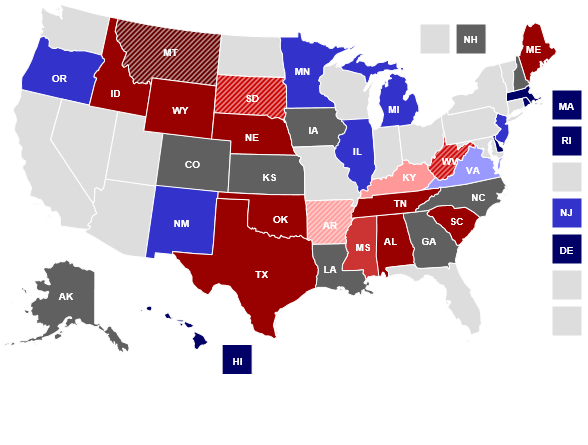
On the eve of this national midterm election polls are continuing to suggest a decided shift in congressional2014_elections_senate_map power. According to Real Clear Politics, current polling indicates 45 Democratic candidates are probable Senate winners, while 47 Republican candidates are positioned to be elected – leaving 8 races considered tossups. If voting plays out as polling suggests – and really, that’s a subject ripe and deep enough for a few hundred theses over the next decade I would think – Republicans only need to win half of those races to secure a 51-seat majority in the Senate.

The Affordable Care Act continues to be unpopular at around 38% of the country having a favorable opinion and 52% having an unfavorable opinion. With Republicans controlling both houses of Congress and their long-standing opposition one would think repealing the ACA would be priority one. But with President Obama’s unequivocal certainty to veto any attempt to repeal the ACA and 60 votes needed for cloture an outright repeal is unlikely. And candidly, a lot of Republicans are not anxious to take away parts of the Act that have proven popular.

So what is likely then. The Senate has never held a symbolical repeal vote, so it will be politically important to Republican Senators they have an opportunity to be on the record as voting for repeal. So we’ll have to endure that circus. Once past the political symbolism I think it is anyone’s guess what’s next. And that’s because it’s anyone’s guess who will ultimately control the soul of the Republican party.

There is the school of thought that a Republican majority in Congress would reflect a referendum on incumbency over frustration with that body’s inability to accomplish anything meaningful. To be sure, it would also be viewed as a referendum on the Administration. But another two years of meaningless symbolic gestures at the President’s expense might not play well for Republicans in 2016, which will be for even bigger stakes. While a more moderate tone from Republicans willing to find common ground with Democrats could lead to modifying and/or repealing the most unpopular aspects of the ACA.

On the other hand, strong-willed elements of the party’s conservative wing could once again seek to hold the Republican Party hostage in the name of being committed to their ideological base. Realizing their only chance of gaining popular support on a national level is to galvanize that ideology beyond current levels of support they don’t have much to lose by risking the ire of those who might view them as obstructionists.

If there were to be some revisions that somehow could be agreed upon by both parties, they would likely need to already have popular appeal – e.g., repeal of the employer mandate provision, repeal of the annual health insurance fee, repeal of the medical device tax – and possibly even repeal, or at least modification of, the individual mandate.

Why are these appealing? Because they lower costs to voters – whether directly or intuitively through the cost of doing business. What is far less attractive are things like repealing individual tax credits and cost-sharing subsidies for health insurance and funding of Medicaid expansion. That leaves a bit of problem for Republicans then, doesn’t it: cutting revenue without cutting expenses while seeking to be fiscally prudent as a primary positioning strategy ahead of the 2016 presidential election.

So how would this be political conundrum be reconciled? Hands, please.

My educated (as in reading the writing on the wall) guess is we will see even more pressure on providers to control costs and system utilization. More emphasis on provider risk sharing. Continued focus on value and tying outcomes to investment. Further support for capitation-based payment models via managed care. Oh, and increased pressure to embrace performance improvement and quality-based systemic approaches that have proven successful in achieving production efficiencies in other industries.

Whatever the outcomes of tomorrow – and however those outcomes manifest in the legislative and regulatory impact on the healthcare industry – all healthcare providers would do well to understand and accept that staying on top of state and federal activities is going to be crucially important to organizational survival.

Cheers,
  ~ Sparky

This Is Not Your Grandma’s Taxi

This Is Not Your Grandma’s Taxi

Having worked with numerous organizations over the years that provide services and care to seniorsDelorean_DMC-12_Time_Machine_in_San_Francisco living in their communities I know that transportation is very often a primary obstacle to expanding and improving those services and care. Whether needed for a doctor’s visit, a rehabilitation appointment, a flu shot, a socialization event, a trip to visit family – it is typically not the distance as much as the inability to coordinate the timing of demand with availability in an efficient manner that creates challenging cost obstacles.

There are organizations across the country that have been effective at tackling this obstacle by leveraging information and communication technology. For example, Senior Transportation Connection serves individuals in Cuyahoga County, Ohio by utilizing mapping and scheduling algorithms (EasyRides©). I had the opportunity to visit their “command center” a few years back and was impressed with how much they are able to do with so little financial support. Truly amazing.

Even so, seniors using STC have to schedule their travel appointments by noon two days prior to the appointed time. It doesn’t take a great deal of imagination to realize there will be many circumstances when the best efforts to plan ahead will fall well short of providing the level of access needed for many seniors still wanting to live independently.

Enter Uber. Jason Oliva writes in yesterday’s Senior Housing News that the San Francisco-based ride service company has just announced it will be expanding its transportation services into San Diego. UberWAV and uberASSIST are ride offerings specifically designed to accommodate elderly individuals living with disabilities.

For those – who until recently included myself – unfamiliar with the Uber concept, the simple genius (yeah, one of those V8 moments I’m afraid) is the development of a smartphone application that connects passengers with vehicles for hire. Not a cab for hire, mind you, but an individual who has signed up and been vetted to provide safe, reliable transportation (yes, I would like to understand that whole process better myself – but that’ not the point of this post).

From a business perspective, the value proposition appears to be the ability to concurrently offer convenience and affordability on the demand side while providing income-earning flexibility and lower barriers to entry on the supply side. As you might imagine, the lower barriers to entry proposition has not played well with taxi and limousine companies – there have actually been protests staged in several countries, including Germany, France and England. I’m sure we’ll get round to it once we get by Halloween.

Now you can just see where this idea is going to eventually cause all sorts of policy issues: free market solutions to public challenges usually do, for better or worse. What are the safety risks? Who is insuring those risks? What happens after the first case of elder abuse is reported?

Having the requisite vehicle apparatus to accommodate disability is one thing – having a driver that can thoughtfully and emotionally navigate through an individual’s confusion and dementia is another. Will seniors be able to use the application in a crisis? Can it/should it be available in cases of emergency? There’s a lot to think about to protect seniors from abuse – intended or not.

On the other hand, if we follow the tried and true path of policymaking we will almost certainly regulate Uber services to the point where a creative solution becomes cost prohibitive. Without market-driven innovation we will never be able to tackle all of the challenges associated with a dramatically aging society.

What do Pub patrons think? Share your thoughts by leaving a comment.

Cheers,
  ~ Sparky

Photo credits:
Delorean DMC-12 Time Machine in San Francisco
CC BY-SA 3.0
Ed g2s – Own work