Medicare Eligibility: The Next Policy Battleground

Medicare Eligibility: The Next Policy Battleground

In Washington this week, discussions continue in an effort to reach agreement on a comprehensive deal that will avoid the impending Fiscal Cliff.  Healthcare remains a central part part of the debate.

While much of the attention regarding healthcare policy over the past few years has focused on healthcare providers and the economics of how those providers are paid – or not – for their services, there has been an elephant in the room all the while that most politicians and elected officials wisely seek to steer clear of: that being, policy decisions impacting the financial burden on Medicare beneficiaries.

With Democrats holding fast to collecting on what they feel the presidential election afforded them – a mandate to raise taxes on the wealthy; and with Republicans demanding real and meaningful action to lower entitlement spending, the Medicare program is very squarely in the horse trading crosshairs.   Of course, there is a lot of disagreement and controversy over whether Medicare should be considered an entitlement.

On the one hand, to the extent Medicare expenditures were funded by beneficiaries through taxation it does not fit the traditional definition of an entitlement like Medicaid or unemployment benefits.  On the other hand, given a myriad of contributing factors (e.g., most prevalently being advancements in medical technology and the accompanying impact on longevity), significantly more is spent per beneficiary today than was contributed.

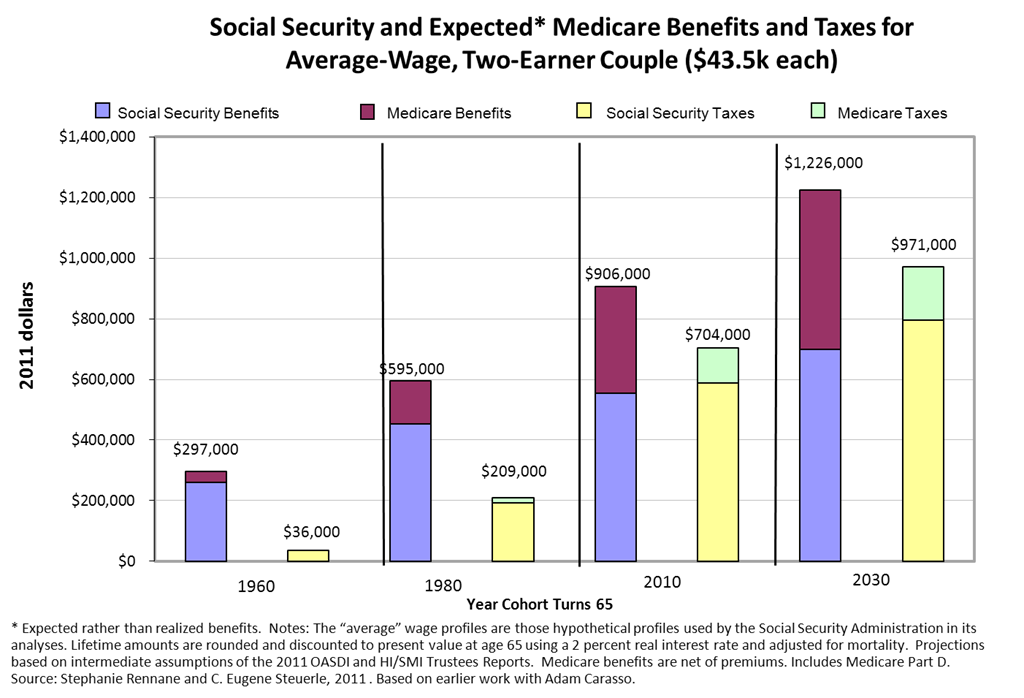
According to an Urban Institute research paper, in 2011 a two-earner couple retiring  with a combined income of apx. $87,500 (defined as the average wage), would have paid about $116,000 into the Medicare program during their lifetimes.  That same couple can expect lifetime Medicare benefits of $357,000 net of premiums.  And given the current trajectory, in 2030 an average-earning couple will pay $175,000 in Medicare taxes but receive a benefit of $527,000. 
image

So call it what you will, in the real world where accumulated deficits are resolved through bankruptcy and/or cessation of operations, the phenomenon described above represents a significant funding gap that results in the assessment of financial burden for Medicare expenditures on a broad base of the population not receiving benefits.  That sure sounds like an entitlement, does it not?

Regardless of what it’s called, the problem with raising the age of Medicare eligibility as a policy solution aimed at closing the funding gap is that it only avoids expenditures for those seniors otherwise able to afford healthcare.  This presents both fairness and pragmatic challenges.  For those individuals in the 65 – 67 age cohort unable to pay the cost of their healthcare, some form of cost subsidy will still be required: whether that is through Medicaid, insurance premium subsidization under the Affordable Care Act or cost shifting in lieu of uncompensated care.

Those challenges are causing some members in Congress to consider Medicare means testing as a potential alternative to raising the eligibility age.  This is an idea that President Obama has also publicly supported in the past.  The approach would lower Medicare benefits as a function of income.  From a purely economic vantage this is a more efficient approach because there is a much higher correlation between the targeted  population of the policy and the desired financial impact on the Medicare program.

Means testing will not be not an easy sell politically, however, when considering the enormous amount of political clout held by that portion of the electorate to be affected.  The media monster that is AARP will almost certainly be effective in portraying any attempt to implement means testing as robbing from the vulnerable elderly.  No easy answers here, folks.

Way back in the day, I used to do a lot of work as a financial advisor and was involved in several debt restructurings.  What I learned through that experience was the best possible outcome meant having all parties involved equally dissatisfied with the result.  I wonder if that’s a scenario that anyone in Washington could possibly accept where a deal on the Fiscal Cliff is involved.

Cheers,
  Sparky

A Moment in Time

A Moment in Time

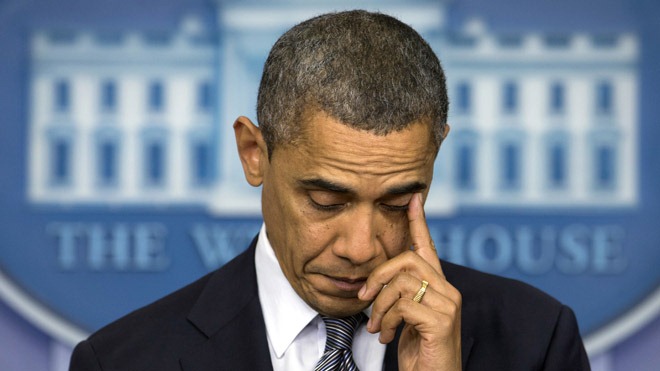
APTOPIX Obama Connecticut School ShootingThere are moments in time that you remember as long as you live.  Despite centuries of history working against us, those moments are able to completely redefine how we view and feel about particular days and months and seasons.  That, unfortunately, is the case today.  The horrific tragedy in Newtown, Connecticut this morning shall live with most of us now forever.

As distant witnesses we are unable to fathom the full measure of sorrow and anger – that gut-wrenching sense of bewilderment and disbelief that must be weighing so heavy on many broken hearts right now.  To commit murder is a unique act of moral deprecation that unto itself carries a sufficiently conscionable disconnect.  But to dig down even deeper into the black abyss of a human soul that has lost its way – and find the will to kill young, innocent children with so much of their lives still ahead of them – no words can possibly do justice.

We will all move forward – because we have to.  Even those whose hearts have been shattered today will also have to move forward.  But we will never move past this moment in time.

While Rome Burns

Quick Take
As reported in The Hill yesterday, Federal Reserve Chairman, Ben Bernanke, shared a dire warning on the prospects for the US economy if our elected officials fail to resolve the critical impasse on how to avoid the Fiscal Cliff.  He also pointed out that the economy is already being negatively impacted because the uncertainty and prospect of going over the cliff is creating havoc in financial markets and impacting investment decisions.

With so much at stake it is beyond disheartening to watch the political posturing of the two extremes of political discourse.  On the Socialist left you have, thou shall not cut entitlements to anyone – while on the Tea Party right you have, thou shalt not raise one penny of taxation

Where do you go from there? That’s like being told to increase production while laying off workers.  Yeah, I know that can and has actually be done, which is another topic for another day – but you get the point.

Our country is being held captive by minority extremists at both ends of the ideological political spectrum – neither minority willing to compromise because being correct in their beliefs is more important to them than being part of a plausible – if not entirely agreeable – solution to the challenges that come with governing. 

I often wonder whether folks who relish in being identified as “part” of a political ideology discover through maturation which ideology aligns with their beliefs – or whether they form their beliefs to align with the ideology to which they seek to be identified as being part.  When someone claims they are a bleeding heart liberal, I’d like to see how much they donate to charity each year.  And when they claim to be a staunch conservative, I’d like to watch them discipline their kids.  Talk is cheap and even more so when emboldened by social media.

My point is that I have had it up to my eyeballs with having minority interests capturing and distorting majority attention – and being an obstacle that is much larger than defined by their electoral power.  Every person I have talked to over the past few weeks – Democrats and Republicans alike – is of a similar mind: both revenue increases (taxes) AND expense reductions (entitlements) are necessary.  I believe the majority of Americans know and understand that.  Do you?

Cheers,
  Sparky

Would Lincoln Push Us Over the Cliff?

Abraham Lincoln was quoted as saying, “character is like a tree and reputation like a shadow: the shadow is what we think of it; the tree is the real thing.”  Now, even in Lincoln’s day the art of politics demanded a steely mental toughness and shrewd negotiating skills.  Lincoln was among, if not the, very best of his day on the national stage in being political.  Daniel Day Lewis gives  yet another phenomenal screen performance in the new movie, Lincoln, in which those skills are brilliantly portrayed.  Go see it.

I do believe, however, our late president would blush with despondency and embarrassment were he to visit Washington today and be witness to the amount of time, energy and resources that are being committed to casting shadows that disappear with each day’s setting sun rather than planting and nurturing trees that will grow and bear fruit for future generations, as his efforts most certainly did.

The art of negotiating has not only been lost, or rather abandoned, in Washington, it has been replaced by the art – if you can call it an art – of manipulating perceptions.  Perceptions (the shadows) are the handiwork of modern media.  And the manifestation of that handiwork now posses the gravest threat yet to our nation’s economy because it is becoming more of a serious threat than I thought possible in being a very real obstacle to finding compromise on how to avoid the Fiscal Cliff.

Real ideas – ones that somebody actually believes in – cannot be brought forth, challenged, discussed and hotly debated when those individuals supposed to be doing the debating are running around chasing shadows like Peter Pan (there is much more you can do with that analogy without a whole lot of imagination).  Over the past few weeks we have watched this play out in the ridiculously lame posturing of elected leaders supposed to be engaged in serious discourse over how to solve this nation’s debt crisis.

Instead, they spend their time and efforts not bringing forth and positioning new ideas – but seeking to deceitfully position the public perception of those with opposing viewpoints (i.e., as in the party opposite).  To hell with ideas.  Who has time for ideas with a 24-hour news cycle and an audience that has a few thousand competing electronic choices for their attention and demanding to be entertained? So we – the audience – have culpability in the charade that plays out every evening on Fox News and MSNBC.

Today we are living in a generation that, on the whole, has benefitted from such largesse that it demands to be entertained – because it has time to be entertained. We seek out and reward through our patronage Soap Opera Journalism.  Controversy and conflict push ratings.  That’s entertaining.  Politicians and elected officials understand the game of visibility – and how costly an advantage that can be to buy.  Want to build visibility in the media without spending more than you can afford? Then you have to be entertaining.

Perhaps the bitterest – if not most distasteful, in my opinion – manifestation of this phenomenon is Reality TV.  Have you ever met anyone in real life who shares with you their most personal thoughts and insights about what is happening in their life while appearing to be talking to the invisible person next to you? That’s not reality.  That’s just content being produced under the guise of reality for the purpose of entertainment.  And, sadly, the same thing can be said about much of today’s news programming.

I wonder what an interview with President Lincoln would like on Fox News or MSNBC.  I wonder if he could possibly fathom what the strategic purpose was of the rhetoric that pours forth every day from what would be considered his antecedent contemporaries in Washington.  I have a feeling he would invoke another of his famous sayings: “I am a firm believer in the people.  If given the truth, they can be depended upon to meet any national crisis.  The great point is to bring them the real facts.”

Well, good luck with that, Mr. President.  The problem isn’t with finding and reporting facts.  It’s with understanding what the term, “real” means today and how that is impacting the way those facts get presented.

Cheers,
  Sparky

Big Data Assimilation

In early October, I wrote a post entitled, Big Data and Brand Management.  In observing the Pub’s recent visit tracking activity that post has been getting some attention – particularly from the Netherlands.  I wish I had the time to investigate further to possibly understand why.

I do know that the subject of Big Data and Healthcare is quickly becoming one of the most intriguing – if not controversial, and to many, threatening – side shows of the big show that is Healthcare Reform and the impending implementation of the Affordable Care Act.

In the IT world this growing attention is seen as an anticipated awareness among the less informed masses to a level of consciousness they achieved over a decade ago.  But for all that foresight, there has been precious little headway made in addressing some very critical issues of access and security.  And that is because those issues are not clearly defined, have dramatic implications regarding personal privacy and must be framed within a context of assumptions about the future that are widely debatable and lacking entirely for empirical support.

There is a lot at stake here:  a huge potential for solving some very challenging social problems – yet just as great potential for infringing upon personal liberty.  While I share the justifiable concern over protecting the privacy of individual patient data and information, I believe that concern is clouding an even greater story here; and that is the alluring diagnostic trajectory that Big Data has launched us upon.

In combining Big Data (large static storage requirements) with highly complex  analytical algorithms (large dynamic memory capacity) requiring tremendous computing capacity (processing speed) what we are essentially doing is seeking to replicate and accelerate the thinking ability of the human brain.  The historically great equalizer of human intelligence has been a life’s experience.  To be sure, there are ways to broaden exposure to circumstances and events that contribute to such experience, but there is no way to accelerate the natural course of observable events, which ultimately comprise the sum total of that experience – nor the wisdom of maturity to make good use of it.

In the book, Blink, by Malcolm Gladwell, he explains the concept of rapid cognition: a fascinating treatise on how our minds instantaneously sort through and combine billions of observational data elements from our life’s experience, analyze the meaning of that data and then form a reasoned judgment about what we have just observed through our senses in a matter of a few seconds.  This is often also referred to as intuition, or a gut feel.  It’s something that has saved many lives owing to physicians’ diagnostic capabilities.

What many clinicians fear in a world of Big Data is an unproven overreliance on information technology to supplant or replace that diagnostic capability (or intuition, if you will).  While, in the aggregate, some of that concern may understandably be driven by a fear of professional obsolescence, I think the much more prevalent concern is challenging whether and when a machine will (ever) be able to truly replace the intuitive capability of the human mind.

And that really is at the heart of the longer-term Big Data dilemma, even if the focus right now is on privacy and protection.  I don’t mean to diminish such concerns, but I do believe we will ultimately be able to address those relevant concerns satisfactorily.

A much more difficult challenge, however, is assessing and understanding whether machines will eventually be able to capture the collective human knowledge and experience that clinicians currently rely upon and be able to analyze and apply that information in a way that achieves better overall patient outcomes than application of human assessment, analysis and reasoning.  And, if so, will patients be able to have access to that computing capability without needing human interface?

Then, what is the role of doctors in the future? Will there be a need for them? Will those who would have otherwise employed their talents in becoming physicians be the future engineers and programmers that work to develop, upgrade and enhance the computing capability of the new electronic caregivers?

A lot to think about.  Big Data offers a lot bigger challenges than just worrying about who owns the data.  The real concern is who is going to control the owner of the data – and how? Star Trek fans, think Borg.  Is that where we’re headed?

What do you think?

Cheers,
  Sparky

Be Thankful for Caregivers

Ah, Thanksgiving.  Time to pause.  Time to reflect.  Time to be thankful.

In the Policy Pub tomorrow guests will be treated to gobs of turkey, heaping piles of potatoes, corn, dressing, relishes, pumpkin pie and a pint or two of Great Lakes Christmas Ale, which never seems to be available very long after Thanksgiving no matter how much they work to increase production every year.

Tomorrow in healthcare facilities across the country caregivers and volunteers will be doing what they do every year: assuming the full responsibility of not only caring for the sick and disabled – but also caring for a fair share of lonely hearts and lost souls.  For many patients and residents of these facilities their caregivers are the most important link they have to a measure of otherwise evasive happiness.  Perhaps that’s an unfair expectation of a group that is already overworked and underpaid – but whoever said there was anything fair about healthcare.

In all of the political wrangling of the past few years that has been Healthcare Reform, it has been easy to neglect – and I have to embarrassingly admit, even sometimes forget – that nothing else really matters in healthcare if these individuals are not successful in carrying out their assigned duties.  Those of us who play a supporting role hope we are employing our talents and efforts to make those duties more productive, less stressful, and more rewarding.  Sometimes the best we can do is to just stay out of the way, which is where having a good sense of humility can be a tremendous asset to someone in a supporting role.

Few are cut out to be successful caregivers.  It takes a rare mix of compassion, mental toughness and fortitude.  And it also requires a personal reconciliation to the reality that the value they create in the lives of others can never be adequately rewarded financially.  Whether or not recognition and praise can make up any portion of that gap – and whether that really matters – I don’t know.  But I thought I would take this opportunity anyway just to be on record as being thankful and appreciative of the work caregivers do everyday in this country.

Cheers,
  Sparky

Time to Move Forward

Last night’s reelection victory by President Obama should finally put to rest the long and bitterly partisan rhetoric surrounding the Affordable Care Act (known more popularly and embraced even by the President during the campaign as Obamacare).

It should – but I doubt it will.  While Repeal and Replace was a catchy enough campaign slogan, the “replace” part never really seemed to be manifested in a way that offered any meaningful alternative that could be widely embraced by a majority of the body politic, even in the face of a staggeringly lethargic economy.

I think it is critically important to remember why that is: because the underlying challenges of healthcare delivery in the United States cannot – and will not – be addressed solely through public policy.  I have maintained since 2009 that the Affordable Care Act can provide a workable framework for achieving cost savings by leveraging market-based incentives while improving access and quality through public-private collaboration and care coordination.  But the future success of Healthcare Reform implementation is now squarely in the hands of healthcare providers and the non-clinical supporting cast that must step up and justify its share of the Big Tuna.

Whether before yesterday you were like the ostrich with its head in the sand or the deer frozen in oncoming headlights, today is the day you no longer can justifiably afford to stay in that position without accepting the responsibility and consequences of  your inaction.  I have written and spoken extensively over the past two years about what healthcare providers must do to be strategically positioned for success under the Affordable Care Act.  I won’t take your time again here to beat that dead horse.

With the final significant challenge to ACA repeal behind us, however, I would like to offer some observations of what I think post-acute/long-term care providers should expect over the next two-plus years leading us into the 2014 bi-election.

Latent Political Opposition
As I write above, while the election should end the political opposition to the ACA, it most certainly will not.  What the President certainly did not win last night was a clear mandate of his political agenda, of which quite obviously Healthcare Reform has been the centerpiece.  The country remains deeply divided on issues that are very difficult to reconcile.  Couple this reality with the looming fiscal cliff facing the US and much of Europe, and there is more than enough political fodder available that opposition constituencies can lean on to push back against implementation.

This will be most acutely felt as we move forward with Medicaid expansion and the health insurance exchanges.  States that have been on the fence – whether perceptually or in reality – will now have to come out from under the election’s shadow and determine – very quickly – whether they will participate in the Medicaid expansion and/or develop their own health insurance exchanges (or allow the Federal government to develop them on their behalves).

Medicaid Expansion
The reality is that most states will find it too politically tempting not to take advantage of federal funding in support of Medicaid expansion.  And so, savvy post-acute/long-term care
organizations will do well to focus a lot more attention – if they have not been already – on what is happening in individual state houses in 2013 and 2014.  Of particular importance and significance, it is going to require a monumental effort to coordinate service and care delivery to the dual-eligible populations.  States will be looking to both insurers and providers to help develop the systemic infrastructure to support Medicaid expansion.  Organizations that participate in, and contribute toward, those development efforts will be much better positioned to financially benefit from expansion implementation.

Discretionary Funding
Another major political obstacle facing ACA implementation will be discretionary funding.  While major portions of the Act – including the core elements of access and coverage infrastructure – were appropriated within the legislation, there are still significant sections where funding was authorized but still requires congressional appropriation (as in appropriated by the House of Representative: still quite firmly in Republican control).

Given the budgetary realities facing the Administration and Congress – and what will likely continue to be the Republicans’ intransigence on income taxes –  it seems logical to expect discretionary funding will be severely threatened.  This will have the greatest impact on workforce educational programs and community-based health and wellness initiatives, but several demonstration/pilot projects, as well as monitoring and technology assistance initiatives could also be negatively affected.

Compromise
What has become the dirtiest word in Washington over the past decade is going to rear its ugly head again – and probably as soon as during this lame duck session of Congress.  The same fiscal concerns that will impact discretionary spending I expect will also be manifested in delays and compromises impacting implementation of both the insurance exchanges and Medicaid expansion – and perhaps even the Individual Mandate.

There will be efforts to tighten up essential health benefits (EHB).  Exchange policy pricing and subsidy values will be challenged.  Medicaid eligibility criteria will be scrutinized.  All this in the name of seeking to limit the Federal government’s actuarial financing risk (and resultant budget impact).  And though it may appear to be counterintuitive in the face of last night’s election, my bet is that Republican resolve to demand spending cuts will be stronger in the next Congress than it has been in the current.  If the Administration wants to raise tax revenues, it will have no choice but to compromise, and not facing the prospect of reelection in four years will be in a better position to do so.

Medicare
And yet we still come back to the singular policy issue that exists beyond the Affordable Care Act: how to control Medicare spending without impacting access in the face of an approaching tsunami increase in demand for care by Medicare recipients.  There is the physician Sustainable Growth Rate (SGR) formula that hangs like a black cloud, imposing a constant threat to any and all implementation efforts.

There is the $716B in Medicare savings upon which the overall economic success of the ACA largely depends.  There are programmatic payment initiatives driving providers toward payment bundling and capitation.  Medicare Reform is a story that has yet to be written, and the ending is no brighter today than it was yesterday – nor would it have been had Mitt Romney and Paul Ryan have won.  The need to produce more, better and faster with less, fewer and cheaper is the stark reality that cannot be taken away by any political party.  Stay tuned for a very rough ride . . .

Final Thought
As I have written before, although the ACA provides a comprehensive framework, much of Healthcare Reform’s ultimate policy development and implementation is still to be created through future legislation and during the regulatory process.  Or another way to look at it is, today is only the end to the beginning of Healthcare Reform.  So let’s get to work!

Cheers,
  Sparky


The Healthcare Value Equation

Prior to leaving for Denver and the LeadingAge Annual Meeting & Exhibition last week I posted here in the Pub several questions I was anxious to have answered by LeadingAge members.  I was not disappointed by the vibrant and impactful discussions and sharing of ideas that has come to epitomize that event.  Indeed, I learned a great deal of incredibly valuable insights, as usual.  But it was what I did not observe that – while not terribly surprising – has me nonetheless concerned about many member organizations’ futures.

Overall, I would characterize the leadership view at most organizations toward Healthcare Reform and its attendant ramifications as being acutely aware, justifiably concerned and yet still very uncertain about what types of organizational changes will be required to survive.  And where there is a greater level of certainty, the perceived changes needed tend to be of a more tactical and pragmatic nature, rather than transformational.

I realize this is to be expected because change is anathema to our human psyche.  Even changes that bring about sought after and desired results in our lives are usually disruptive, requiring adaptation, resiliency and an unplanned exertion of focus and energy.

The dynamics of organizational change are such that if you take the individual energy required to adapt to change and then multiply that by the number of individuals comprising an organization, the product will be exponentially higher.  This is primarily owing to differences in the means and speed at which individuals accept and adopt to change.  And the process by which an organization reconciles these differences is a function of effective organizational change management.

Whenever I give a presentation on Healthcare Reform I share what I have learned as a student of Michael Porter’s work on Value-Based Healthcare.  I seek to convey the singular concept that will serve as the platform upon which all future performance improvement efforts must be based.  I refer to this concept as the E = mc2 of future healthcare delivery: Value = Outcomes/Cost.   This is also the formulaic basis upon which leadership teams at organizations that provide healthcare must base their organizational change efforts.

This may seem like a simple enough concept, particularly when we compare its application in almost any other industry in which a product or service is exchanged for currency (or another product or service).  In healthcare, as we know, our delivery system has largely obfuscated the applicability and worth of this formula – first through employer-provided insurance beginning during World War II and then several decades later and subsequently through complex provider payment designs developed by Medicare, Medicaid and commercial insurers.

As Porter asserts, today healthcare providers compete on bargaining power, volume and control of the patient, rather than value.  The demographic and economic realities of this 21st century require a paradigm shift in the competitive model of healthcare delivery, where market advantages will be achieved through actual and perceptual positions of value created for the patient.  Such a shift cannot be achieved through incremental improvements in cost reduction and process improvement – however grandiose the means of pursuing such goals may be.  It requires a transformational shift in how the healthcare organization views itself.

It also requires a new way of thinking about how we understand and define Outcomes; and how we track, analyze and report on Costs.  I will write more on these topics in the future.  But for now, my message is that those senior housing and care organizations that embrace this way of thinking – and determine how to manifest an organizational strategic positioning based on value – will be much more likely to survive and even thrive in the future. 

Cheers,
  Sparky

Big Data and Brand Management

Big Data: big opportunities or big problems?  While most of what I have read seeks to position this question in the context of anticipated investments in human resources and IT infrastructure, I have a different take.  I think the most critical and salient difference in determining whether Big Data has positive or negative implications for healthcare providers will depend primarily on whether and how effectively it is utilized and managed in organizational branding.

Part I ~ Implications of Big Data
In explaining this, let’s start with a look at just a few examples of where and how Big Data will impact healthcare organizations. 

Clinical and Epidemiological Research
Healthcare providers have long been cognizant of the important role that cutting edge clinical and epidemiological research plays in helping educate and prepare them to provide evidence-based care.  They are also aware of the tremendous burden that misguided and/or shoddy research creates on both their time and talents.

At a clinical level, Big Data means being able to utilize previously prohibitive quantities of biomolecular data to test relational hypotheses much faster, while at the epidemiological level it means being aware of social cause and effect relationships much sooner.  In either instance, the impact and expectations of what to do with more information at an accelerated rate will have a significant impact on healthcare providers, as well as patient-consumers.

Consumer Empowerment
There are already literally thousands of smart phone/tablet app’s available to help individuals manage there own care.  A quite natural focus among these has been to design applications targeting chronic disease management.  As the Boomer age wave grows, so too will that portion of the patient population that is not only adept but very conversant in using electronic data and information to be highly informed and highly motivated self-care advocates.

Transparency
Though Big Data is by far not the only force driving greater transparency of financial and operational performance metrics from healthcare providers, it will be the catalyst that transforms those metrics from merely data to usable information – and unfortunately, probably a good deal of misinformation as well.  Providers will have to be both cognizant and vigilant in assessing how this emerging trend will impact their market positioning.

Implications
The common thread of these three examples is what I call the Acceleration of Digital Chaos©.  More data is always beneficial to the extent that it creates greater awareness, enhances education, expands knowledge – and most importantly, creates wisdom.  But as we know, more data does not always lead to such hopeful results.  It also often leads to more confusion, more frustration – and worst, more risk of making critical decisions based upon faulty analysis.

Part II ~ The Importance of Brand Management
Wherever there is chaos and confusion that grows out of attempts to address a basic human need like healthcare, so too exists the double-edged sword of opportunity and risk: the opportunity to bring clarity amidst the chaos in the form of high-value solutions, as well as the ever present risk of making things worse.  And there too lies the associated challenge of branding: opportunities to leverage Big Data in ways that can greatly enhance the value of your brand – or facilitate its disintegration into a pile ashes.

To make sure Big Data serves your brand rather than destroys it will require an active awareness and understanding of where and how Big Data will intersect with Brand Management.  Several examples of these intersections are offered for your consideration.

Social Media
Social Media continues to grow in importance and relevancy to the healthcare industry.  Enter Big Data and now you have a tremendously powerful vehicle for gaining valuable information and insights on patterns and behaviors – of both consumers and competitors.  

To the extent a knowledge advantage can be gained through use of Big Data, that information can be used to help position your organizational brand in concert with consumer demands and expectations – and before competitors achieve that positioning.  I cannot think of a more important market-oriented investment that healthcare providers can make at this time than exploring and understanding how Big Data will transform the way data collected through Social Media can be used to competitive advantage.

Quality and Integrity
Examples in Part I above highlight the likely potential where Big Data will generate tremendous personal anxiety, confusion and frustration.  Take the average consumer-patient looking at knee-replacement surgery in the year 2015.  Armed with 30 published research papers on the advantages and disadvantages of different techniques; over 50 web site addresses stored in the web browser with pages and pages of performance data on surgeons;  15 different self-help iPad applications downloaded to determine the most effective means of post-survey rehabilitation.  You get the idea.

So the ability of healthcare providers to be perceptually positioned as a trusted resource to cut through all of the confusion and frustration will create substantial market advantages.  But, importantly, those healthcare providers that are able to achieve a sustainable advantage will not only facilitate a more efficient and helpful pathway through the confusion – but they will do so while backing it up with consistently higher quality care than competitors.  The two must go hand in hand.

Data Security and Corporate Compliance
I saved the most important for last.  This is a hugely tremendous risk to brand value that will be attendant to using Big Data.  We read of examples every day where patient data has landed in the wrong hands.  The consequences of being at fault – whether real or perceived – for a breach of data privacy and protection could erase years of investment in building your brand overnight.

Yet it is reasonable and plausible that a breach could happen despite the most advanced and diligent efforts of prevention.  In such instance, the organizational fallback position must be a strict adherence to corporate compliance policies that clearly make the protection of personal data the highest priority – not only in theory but in practice.

Please note this post is not by a stretch intended to be an exhaustive survey and consideration of either the ways in which Big Data will impact healthcare, nor the numerous ways in which it has the potential to impact healthcare providers’ brands.  It is intended primarily to help leadership teams of such organizations begin to perform their own assessment of how and where Big Data can have a Big Impact on their future branding efforts.

Cheers,
  Sparky

Shoots & Ladders and US Healthcare Delivery

Shoots & Ladders and US Healthcare Delivery

imageI just wanted to share a quick thought before I lost it.  Do you remember playing Shoots & Ladders as a kid? Do you remember playing Shoots & Ladders with your kids?

Well I was thinking recently of how I would try and graphically depict  our current US Healthcare System to an alien with whom language would be a decided communication barrier – and this is the image that came to mind: a virtual salmagundi of disjointed pathways that individuals are required to navigate during periods in their life when they are least able to do so.  Throw in  the moving staircases of Hogwart’s Castle in the Harry Potter series, and you probably have a pretty accurate depiction of what our healthcare system looks like from a patient’s vantage.

Imagine though if the Shoots & Ladders game board were redesigned.  Instead of having equal squares representing a static and linear path that must be followed – left to  right, going up a row at a time, hoping that you get the care you need by landing on the right space and hoping you don’t get shot off into the wrong direction – what if there were one square (or better yet, circle) in the middle.  That would be where the player (patient) starts.

Then imagine we get rid of the ladders, because although they represent the benefit of jumping ahead in line, they also represent having to climb; and there are, of course, OSHA considerations.  Let’s instead keep the shoots, but make them work to our advantage.  Realign all the shoots so that they flow out from the center and to the several destinations that represent that element of the healthcare delivery system the patient needs.

Around the board then you have the physician’s office, the hospital, the clinic, the lab, the specialist’s office, post-acute/long-term care facilities …  You get the picture, and one can only take a metaphor so far when the subject matter you’re trying to explain has the reality of life and death attached to it.

Of course, what I am describing here is a holistic system of care delivery that puts the patient at the center of all providers and services – all the time; instead of being the center of attention of one provider at a time, 15 minutes at a time, as his or her time allows.  Instead of the patient having to navigate the system, the patient is surrounded by the system and controls the system.

So what has to happen to realize this vision? For starters, we need to find some common public policy ground as a nation.  What neither political party seems capable of accepting – motivations notwithstanding – is that being in the middle of a battlefield is worse than being on either side.  The inability, or rather unwillingness, to compromise is killing this country, and along with it the hope of having any type of a person-centered healthcare delivery system.  The winning-at-all-costs attitude that pervades our political conscious is quite ironically going to end up causing us all to lose a lot.

There are also substantial and difficult individual behavioral changes that need to take place in our country as well, and these aren’t confined to any individual constituency.  Providers need to tear down the silos that have long stood as obstacles to sharing knowledge and information.  Insurers need to accept those providers as partners in striving for shared goals and objectives.  And patients need to assume a much greater level of responsibility for their health – and the consequences of decisions made from which their health suffers.

Often lost in the political maelstrom that has become Healthcare Reform of the 21st Century are the underlying trends and drivers of which the Affordable Care Act was as much a codification of as it was the creation of any bold new initiatives.  Good things happen when people communicate effectively.  Healthcare costs less when production is streamlined and coordinated.  And people contribute their greatest talents when their environment is stable and they feel safe.  So simple even a four-year old could play the game.

Cheers,
  Sparky