“The Doctor Will Skype You Now . . .”

“The Doctor Will Skype You Now . . .”

healthcare-marketing2-300x199In this month’s edition of the McKinsey Quarterly is an insightful article: Six social-media skills every leader needs.  If you are either currently – or aspiring to be – in a position of managerial leadership at any level of your organization and plan to work for more than a few more years, this is an article you need to read.

And if you are working in healthcare, I think you will find the personal and organizational ramifications of the Six Dimensions of Social-Media-Literate Leadership model presented in the article to be particularly exciting – and troubling.  Because of the inherent nature of the industry’s product (i.e., human health), the potential benefits and threats presented by social media are accordingly heightened.  When messaging distribution spins out of control and goes viral at a manufacturing concern someone could lose face.  When messaging gets convoluted in a hospital someone could lose their life.

The opportunities for creating organizational value through social media are vast and still largely untapped.  For example, the ability to engage and capture a broad spectrum of individual thinking; the ability to facilitate collaboration and engagement across social and cultural barriers; the ability to build brand loyalty through direct communication; the ability to accelerate innovation.

The other side of the social media sword is just a sharp – and even more so in healthcare.  Risks of individual privacy are at the forefront.  But there are also tremendous risks associated with distribution of disinformation, as well as the misuse and/or misunderstanding of credible information.

As the article points out, “the leader’s task is to marry vertical accountability with networked horizontal collaboration in a way that is not mutually destructive.”  How is this done? I have highlighted below the key points I took out of the article.

Accept Reality
Whether appreciated or not, social-media is a transformative disruption that is changing the way organizations operate (their structure, their strategic positioning, their business models).  The article describes McKinsey’s work with General Electric’s leadership in their social-media-transformation.  It is not a fad of the entertainment-minded pre-Baby Boomer generations.  Ignore its implications on the future at your own peril.

Learn to Let Go
The days of being able to carefully plan, construct and deliver your message via traditional forms of media (i.e., whether through print, e-mail or video) are quickly waning.  Today’s distribution network has been turned upside down: the message often starts with social communication and then gets crafted, molded and morphed into new meaning as it cascades upward through organizational hierarchies.  Recognize sooner rather than later what this means for your ability to control messaging.

Embrace – and Learn – Media Technology
In social-media risk mitigation, the best offense is a good defense.  The sheer volume of information bits from e-mail distribution, networking and news aggregation is overwhelming for most of us.  Being able to use tools that help navigate and focus your attention on highest priorities is essential.  Also being able to understand when, how and in what context your messaging will be received should help guide your communication style.  There are some wonderful software applications to increase your abilities in this area.

Stay Tuned In
Part of GE’s Leadership Explorations program includes reverse mentoring, where senior leadership is able to engage with media-savvy millennials to accelerate their knowledge and understanding of emerging social-media technology and applications.  Staying on top of the social-media evolution takes precious time that has to be diverted from more meaningful endeavors.  In other words, time has to be made to stay on top of it.

Be Cognizant and Be Careful
If you are familiar with the old adage, Some things are better left unsaid, then internalize that phrase and broaden its application to any potential means of sharing a thought via social media.  I have been personally mindful of the line from Kipling’s poem, If: “If you can bear to hear the truth you’ve spoken twisted by knaves to make a trap for fools . . .”  Unfortunately, that
is an inherent risk that comes with raw and transparent communication. 

Healthcare organizations – and their leadership teams – that “get” the socially and culturally transformative implications of social-media will note in the model presented by McKinsey aspects that reflect their own evolution.  They will be able to recognize and identify with the opportunities and challenges presented because they have already begun to experience both firsthand.

For those who don’t get social-media, well as was written in a Western Union internal memo in 1876, “this ‘telephone’ has too many shortcomings to be seriously considered as a means of communication.  The device is inherently of no value to us.”

Cheers,
  Sparky

Chaos Theory & Doc Shortage

A major concern of policy analysts regarding the Affordable Care Act is whether and how the country will be able to produce a sufficient supply of primary care physicians (PCPs) to meet the projected demand arising from extending healthcare coverage.  But to what extent future demand for PCP services will be owing to demographics versus expansion in coverage requires the use of some rather subjective assumptions.  While it is plausible to assume that removal of cost as an obstacle to healthcare utilization would increase demand among that portion of the population unable to afford coverage, such thinking can also be counterintuitive.

According to a 2012 article published in the Annals of Family Medicine, Projecting US Primary Care Physician Workforce Needs: 2010-2025, “with nearly 209,000 PCPs in 2010, the United States will require almost 52,000 additional PCPs by 2025—about 33,000 to meet population growth, about 10,000 to meet population aging, and about 8,000 to meet insurance expansion.”  There are numerous similar studies using different methodologies and approaches and different (hypothetical) assumptions, but most all I have seen support the challenging reality that demand for PCP services is going to substantially outpace supply given the historical rate at which new physicians enter the workforce.

In reaction to this concerning challenge, the journal Health Affairs recently published a paper that argues the projected PCP shortage can be largely addressed by using teams, better information technology and sharing of data, and non-physician professionals (i.e., physician extenders, such as Registered Nurses, Physician Assistants and/or Nurse Practitioners).  I fear again, this may be a situation where the reliance on subjective assumptions produces desirable findings from sound research practices that won’t bear out over time.

I think it also illustrates – and this is really the larger point I wanted to make with this post – where very often healthcare policy research methodologies inherently rely upon linear dynamics to study problems that really require a nonlinear dynamics approach.  And understandably so.  If you want to produce a movie using a still frame camera, you had either be extremely fast or quite imaginative.  You work with the tools at your disposal.

As advances continue in information technology computing power and capacity (i.e., Big Data), the ability to model nonlinear relationships will increase.  But the nature of unpredictability in human reactions to environment and circumstances will still be a difficult challenge.  There is quite a body of interesting literature suggesting ways in which nonlinear dynamics (e.g., Chaos Theory) can be adapted in social policy research, which is well beyond my purpose here.  But to be sure, the observations I offer on the subject are neither unique or original.

As a more practical matter, however, I think the ideas presented in the Health Affairs paper are viable and will probably result from being as much a function of necessity as requiring support of public policy.  But the nature of how these clinician-patient relationships form and whether or not they will be sufficient to meet the projected demand for PCP services really cannot be predicted because of the modeling constraints of linear dynamics.

Unfortunately, there are usually significant limitations to what healthcare policy research can offer in terms of predicting the future benefit of what appear to be good ideas.  On the other hand, fortunately, the lack of a projected empirical benefit has not been an obstacle to the pursuit of good ideas throughout the history of mankind.  The historical resolution of these two realities has always been the economic reward for the risk taken in pursuit of an idea that lacks a demonstrable benefit.  The challenge we face today is our inability to accept the consequences when that pursuit does not bear fruit.

We love being rewarded.  Paying the Piper – not so much.

Cheers,
  Sparky

Acute & Post-Acute/Long Term Care: How to Have That Difficult Conversation

We’ve all experienced times in our lives when we have to face a difficult conversation and the angst with which we anticipate its completion.  An example might be the nervousness and anxiety of approaching someone to whom we are romantically attracted.  Another example would be the dread and sorrow of approaching someone with news we know will devastate them.  More relevant to my purpose here are the myriad types of challenging but routine conversations that fall well within those two extremes.

In particular, I am referring to the conversations that are now beginning to take on a true sense of importance and urgency between leadership teams at acute care organizations and post-acute/long-term care (PA/LTC) organizations.  Whether driven by regulatory influence (e.g., the Hospital Readmission Reductions Program), new payment models (e.g., bundling pilots), cost containment initiatives or wanting to truly develop a full continuum of care, hospital administrators are getting earnestly engaged in wanting to understand how PA/LTC providers can help them reduce average length of stay and avoidable readmissions.

For healthcare organizations used to operating in silos, discussing subjects like strategic objectives, market positioning and perceived organizational strengths and weaknesses with other healthcare providers – let alone non like-kind providers – can be a most uncomfortable experience.  And that discomfort can cause such discussions to be entirely unproductive.  Time-wasting in today’s healthcare environment will not only put an organization at a competitive disadvantage – it is a short and narrow path to economic collapse.  So the obvious challenge is how to make sure such conversations – or meetings – are both meaningful and productive. 

From what I have observed and experienced over the past couple of years as a party to a number of these leadership conversations, there are some basic, yet very important, guidelines you can follow to help ensure the time you spend is productive and of value.  I have shared these below and hope that you find them useful.

Create a Statement of Purpose
How many times have you been to a meeting where a colleague says to you under her breath, “why are we here?” A Statement of Purpose should provide a clear articulation of why you are meeting and what must absolutely be accomplished for it to be a valuable use of everyone’s time. 
For example, a Statement of Purpose might read,

We will meet on <date> for the express purpose of creating a shared understanding of the joint-venture opportunity being considered, the attendant opportunities and risks, and whether both parties have sufficient interest in pursuing the joint-venture further.  Evidence of that interest will be satisfied if the parties enter into a Letter of Intent within 30 days following the meeting.

Drill Down on Your Value Proposition
Before meeting, have a very good understanding of why a potential venture or opportunity would be of value to your organization.  Define that value nominally (i.e., put it into real numbers).  For example, know that if successful, the project will add a net cash benefit of $X annually to your organization.  It is typically difficult to quantify economic success given the level of ambiguity at the early stages of discussion, but most executives I have worked with are usually surprised at the analytical specificity achievable when they are forced to work through assumptions and parameters.  And it is the very development of those assumptions and parameters that should serve as the meeting content (see next guideline).

Avoid Meeting Until There is Something to Discuss
I had a physician colleague tell me once that thousands of great ideas are presented and discussed at lunch tables across the country every day, yet very few ever make it back to the office – let alone to the type of initiative that merits having two organizations meet to discuss.  As Ashleigh Brilliant once wrote, “Good ideas are common – what’s uncommon are people who’ll work hard enough to bring them about.”

Generating interest and enthusiasm for a good idea (e.g., a joint venture) is usually a pretty enjoyable experience, so there is the natural inclination to want to meet and share that idea.  In my personal experience – and a lesson I had to learn the hard way – this is where most often ideas go to die.  They literally get talked into submission from exuberance over the imagined benefits before they can gain any traction and the support necessary to make it past lunch.

This is why taking the time and effort to develop the business case for a proposed venture before bringing the two parties together is so crucially important.  The level of detail should obviously be in sync with the desire to maintain a strong position of negotiation, but both parties must be able to understand the fundamental framework and objective reasoning that merit the time being committed by individuals attending that meeting.

Set Discussion Boundaries
Both parties should know in advance what they are willing and prepared to discuss.  As mentioned above, there ought to be a cognizant recognition that while bargaining in good faith should be a given, information is power in negotiation.  And while meeting to determine whether a potential venture merits further investment may not represent significant exposure, all too often information is exchanged without due consideration.  Of course, having a nondisclosure agreement in place is wise, and the terms and conditions will provide valuable guidance in establishing your conversational boundaries.

Have the Right People There – And Have Them Focused
With the advances made in information technology over the past decade, the ability to communicate with someone has never been easier – yet being heard has never been more challenging.  Competing for attention is one of the greatest singular obstacles to advancing organizational initiatives today.  It often requires a fair amount of dogged commitment, humility and political savvy to coordinate schedules in a way that gets the right people at the meeting in a frame of mind to concentrate on the meeting content.  But it is an effort that cannot be minimized without jeopardizing success.

Consider Using a Facilitator
Having a productive meeting often depends on the ability to stay focused on the deal points and ensuring you have the right levels of individual participation.  Personality types often dictate that level of participation, and without an objective means of balancing certain types, a few people can dominate the discussion – even if they aren’t the ones empowered to make decisions. 

Having a clearly defined agenda and a third-party facilitator that is familiar with your industry and business can add significant value.  That individual should have experience in effectively managing discussions and debate, ensuring that key concepts are introduced at just the right moments and have the ability artfully keep participants focused on the primary elements that comprise the Statement of Purpose.

Summary
Environmental trends and drivers are pushing acute and PA/LTC leadership teams to accelerate their interest in partnering on market initiatives that require collaborative efforts.  From the very beginning, the success of such initiatives depends on the ability to engage in meaningful and productive conversation.  By having the discipline and foresight to follow some basic guidelines those leadership teams can help avoid wasting valuable time.

Cheers,
  Sparky


Obama’s Opportunity Missed

The human mind can be a very scary place.  There is where originates the electrochemical impulses that direct the body in carrying out some very heinous acts – such as the violence witnessed in Newtown, Connecticut just over one month ago today.

The mind can also be a fascinating study of unimaginable intricacy. In some infinitesimally small space wherein exists a hidden mystery explaining the difference between a physiological existence and conscious existence lies all of the energy necessary to create and destroy humanity (sort of like Einstein’s Special Theory applied to neural mass). Can you think of a more interesting basis upon which to initiate a metaphysical discussion over Creationism?

But alas, this isn’t Sparky’s Philosophy Shop.  As alluded to above, the topic of this post is Mental Health and the policy discussion it is receiving in lieu of the fatal connection between mental illness and gun violence.  Earlier today, President Obama announced a Plan to Protect our Children and our Communities by Reducing Gun Violence.  The plan outlines a number of initiatives – including 23 Gun Violence Reduction Executive Actions – that, taken together, is an attempt to put forth a reasonable agenda on gun control policy.

Of course, the cable news networks will be filled over the days ahead with talking heads who would have us believe we are now full bore on the doomsday expressway with the only two exits ahead being socialism or anarchy – and little room in between to continue having intelligent and constructive debate on how to find the most broadly acceptable policy balance between honoring and defending the second amendment while doing whatever is possible and pragmatic to prevent future tragedies like that at Sandy Hook Elementary School.

I hope rigorous and informed debate continues on the role mental illness plays in the tragedies that have brought us to this place.  And I desperately hope that debate will raise awareness of just how acute the challenges are we face as a society  resulting from mental and behavioral health issues.  If you have not already read Liza Long’s blog post, I am Adam Lonza’s Mother, it poignantly depicts the painful and helpless reality that mental illness can cause in a family.

I believe the President’s Plan on gun control offers some reasonable ideas, most of which probably won’t go very far in the House – partly because their source is the White House and partly because of understandable concerns by some House members that significant elements of their constituencies equate any discussion of gun “control” with an armed government takeover.  But the politics of gun control aside, the reality is that very often a mentally ill individual with an agenda can kill with or without a gun.  Getting guns out of the wrong hands does not address this challenge.

Or, to look at it another way – if I had to choose one investment over the other as having a greater long-term probability of reducing gun violence, I would choose investing in mental health over more gun controls.  Yet while mental health is addressed in the President’s plan, it seems like it was almost an afterthought.  The irony is disturbing because not only do policy issues stemming from mental illness and gun violence warrant a great deal more attention – but so do a host of other issues that recognize the growing awareness of the costs that poor mental health have on society – especially healthcare costs.

Although it is still a very long journey, every day science advances a step closer to understanding the raw dynamics of how the mind and body work in synthesis to have a dramatic impact on our health. Community and individual health and wellness initiatives are now focused on taking a holistic approach.  The connection between mental health and chronic disease and disability, particularly in the senior population (see my post on substance abuse among that population) offers promising opportunities to reduce disease incidence and increase the value of treatments.

To achieve the benefits of those opportunities, however, mental and behavioral health services must be socially and culturally viewed on a par with traditional medical/health services.  In defining essential health benefits that insurance companies must provide, the Affordable Care Act helps advance that initiative.  It falls short, however, of achieving true parity status for mental and behavioral health services.

The President attempted to address that discrepancy today through executive order by committing to finalize health parity regulations – and he also outlined the need to bolster mental health counseling and awareness through additional resources that will certainly not be forthcoming from a Congress (which includes the Senate) that cannot even agree to disagree for fear of reprisal (or am I getting that confused with accountability).  But I think the President missed a tremendous opportunity today to raise awareness and urgency on the critical role mental and behavioral health services must play in developing a healthcare delivery system that is truly committed to improving outcomes while reducing costs.

Cheers,
  Sparky

Such is Hope

Among the numerous provisions included in the Taxpayer Relief Act of 2012 impacting healthcare organizations was the establishment of a new Commission on Long-Term Care.  Now we can rest easy that the demographic tidal wave threatening to destroy our society has (or at least can now) be averted.  Excuse the sarcasm, but it seems I’ve been here before, haven’t you?


While there are specific expectations and deliverables outlined in creating this new commission (see below), vesting authority in 15 individuals to investigate and discuss the problems and then suggest what are sure to be already well-documented ideas offered as solutions doesn’t quite seem to have the legislative teeth one would expect if this effort were to be any more seriously supported than was CLASS.  Assigning yet another committee to tackle the fiscal realities of our nation’s future long-term care challenges is a bit like – well, like the way our elected leaders addressed the Fiscal Cliff.

As I predicted in my post on December 26th, what played out during the first few days of January in Washington was largely just another political fiasco of kicking the can down the road once again.  And if you have had any experience in long-term care you most likely consider that par for the public policy course, so from that vantage I guess the new Commission should be taken in stride.

Section 642 of the Taxpayer Relief Act permanently eliminated the CLASS Act, which was included as Title VIII of the Affordable Care Act.  CLASS (Community Living Assistance Services and Supports) was developed as a voluntary, government-administered program that would have provided a basic lifetime benefit of at least $50 a day (indexed for inflation) in the event of prolonged physical illness, disability, or severe cognitive impairment (e.g., Alzheimer’s disease).  At its core, CLASS was an attempt to provide individual savings incentives to defray the potential future costs of long-term care where private long-term care insurance has largely failed as an aggregate solution.

As may be recalled, in October of 2011 HHS informed Congress that it was unable to ensure the program’s financial solvency over the 75-year period that was statutorily required.  Shortly thereafter (as in the time it takes between a green light and the New York cabbie behind you to honk his horn crossing 42nd Street during rush hour), Secretary Sebelius and the White House quickly abandoned whatever support there may have been.  And thus, death be to CLASS.

The sad financial irony of this, of course, was that CLASS comprised roughly one-third of the projected $210 billion in savings the ACA was to garner between 2013 and 2019.  Indeed, substantial projected savings were verified by the CBO during the 10-year scoring window, but that did not account for the program’s benefit obligations over a 75-year period (i.e., the program would not limit the benefit duration and all future payouts had to be funded entirely by premiums paid by individual participants).

So in what can only be seen as a standard course of appeasement, Section 643 of the Taxpayer Relief Act created the Commission on Long-Term Care.  The Commission’s objective is to, 

“…develop a plan for the establishment, implementation, and financing of a comprehensive, coordinated, and high-quality system that ensures the availability of long-term services and supports for individuals in need of such services and supports, including elderly individuals, individuals with substantial cognitive or functional limitations, other individuals who require assistance to perform activities of daily living, and individuals desiring to plan for future long-term care needs”"

See, I told you you’d feel better.

The Commission is to consist of 15 members appointed not later than February 2nd by the President and majority and minority leadership from both Houses of Congress.  Further, it is to be comprised of individuals representing  consumers, older adults, individuals with cognitive or functional limitations, family caregivers, direct caregivers, private long-term insurance providers, employers, state insurance departments and State Medicaid agencies (all represented by 15 individuals mind you – what an eclectic group that will be).

In developing a plan to address future long-term care needs, the Commission is to provide recommendations that address where and how needed services and supports are currently provided for (or not) through existing governmental programs; improvements necessary in such programs to ensure future availability; and a variety of issues related to workforce adequacy, skills and capabilities (the most important element of this effort, in my opinion).

Then, no later than six months following appointment (i.e., early August of this year) the Commission is to provide (assuming it is in majority agreement) a comprehensive and detailed report, including any legislative or administrative action necessary to carry out its recommendations or proposals.  Subsequent to that (within 10 days) the “Commission bill” will be given to the President, the Vice President, the Speaker of the House of Representatives and the majority and minority Leaders of each House of Congress – and then subsequently introduced as proposed legislation into the House and Senate (by request).  The bill will also be made available to the general public at or around the same time.

I don’t know whether this new Commission holds out any greater promise of addressing the monumental challenges we face in trying to accommodate the future long-term care needs of an aging population without bankrupting this country.  My skepticism is not so thinly veiled in what I share above.

But I am more than willing to take the high road and give it my best shot.  I would like to think that readers stopping by the Policy Pub have a lot to offer in the way of input and ideas the Commission should consider.  To that end, I will do what I can in this space to track its formation and progress – and advise when and how those ideas might best be communicated collectively.

Until then, a quote from someone I know would have made a wonderful Pub patron:
”Such is hope, heaven’s own gift to struggling mortals, pervading, like some subtle essence from the skies, all things both good and bad – as universal as death, and more infectious than disease!”
  ~ Charles Dickens

Cheers,
  Sparky

Healthcare 2013: Get Ready for a Wild Ride!

Healthcare 2013: Get Ready for a Wild Ride!

cedar-point-4With the impending blizzard ready to ruin, or at least significantly delay, one of my favorite holiday traditions – taking down the outside lights and decorations – this seems like a good time to throw another log on the Pub’s corner stove and set upon contemplating what’s just around the bend.  With implementation of the Affordable Care Act now ready to swing into full motion in 2013, might as well use this downtime to start preparing for the wild ride ahead.  So here are a few items on the horizon.

Fiscal Cliff Resolution
As written about here before, how Congress and the Administration resolve – or don’t – the Fiscal Cliff will significantly impact implementation of the Affordable Care Act in 2013.  Neither political party wants to risk being blamed for going over the cliff; yet neither wants to be blamed for, “giving in” on principles.  The resolution? Why, kick the can over Father Time’s head, landing squarely in Baby New Year’s lap once again, of course.  That means having temporary legislation in place to avoid the most feared short-term economic impacts (e.g., avoidance of broad income tax increases, extension of unemployment benefits and forestalling the nearly 30% reduction in Medicare payments to physicians).

Unfortunately, what it is does not mean is any real sense of stability or reliable framework for budgeting and appropriating funds.  Though funding for many of the ACA provisions was appropriated as part of the Act, the interconnected nature of the federal budget means that discretionary funding will still have a great impact on HHS departmental planning and implementation.

Further, it is likely that any meaningful and sustainable fiscal policy compromise will involve some legislative modification to the ACA – i.e., particularly in lieu of the need to control entitlement spending.  So until a long-term bargain can be reached there will continue to be a lot of uncertainty on the actual means, methods and timing regarding key provisions of the ACA.  Notwithstanding such uncertainty, below are a few of the more significant items that are supposed to be implemented in 2013.

Health Insurance Exchanges
Health Insurance Exchanges (HIEs) must be certified and operational by January 1, 2014.  A
t the latest count,  upwards of 30 states have opted not to establish health insurance exchanges on their own, which by default means the federal government will have to set up HIEs in those states.  While portions of the underlying technological and operational infrastructure can be duplicated from state to state, there is still an enormous implementation effort beyond what was anticipated.  Implementation will likely be delayed even with a fiscal agreement in place.  Likely too, will be modification to the Minimum Essential Benefits definition in lieu of projected exchange plan pricing.

The HIEs will get a lot of media attention in 2013 because of the direct impact they will have on millions of individuals and the lightening rod they are likely to become as a portended bell weather of ACA failure once implementation challenges and frustrations emerge.  At the same time, private insurance exchanges – seizing the opportunity to gain comparative perceptual market advantage – will flourish.

Medicaid Expansion
To be – or not to be – morally supportive of providing access to life saving healthcare to your poorest citizens, that is, as some have framed the debate over Medicaid expansion.  Effective January 1, 2014, Medicaid coverage is to be expanded to include individuals between the ages of 19 up to 65 (parents, and adults without dependent children) with incomes up to 138%  of the Federal Poverty Level (based on modified adjusted gross income).

More than likely, most states will find it politically unpalatable to opt out of the federal expansion once the dollars begin flowing out of Washington.  But as written here before, Medicaid coverage is a particularly sharp problem within a thicket of thorny policy challenges.  It behooves any healthcare provider with exposure to Medicaid (i.e., particularly those PA/LTC providers) to be very aggressive in staying informed regarding state Medicaid program policy developments over the next two years.

Medicare Bundled Payment Program
Payment bundling is perhaps one of the most confusing concepts in a sea of confusion that is healthcare policy because the concept both actively precedes and  transcends the ACA.  Pilot programs and demonstration projects testing whether paying multiple providers a lump sum to coordinate treatment and care of a patient for a defined condition and/or disease have been met with mixed results.  Still, provider enthusiasm to participate in such programs seems to be growing.

The difference in 2013 is that the ACA mandates CMS to begin a Medicare bundled payment pilot program to begin in January and run for five years.  The impetus of this initiative is try and drive broader, sustainable alignment across providers.  This is a voluntary program requiring application and must include a hospital, physician group, skilled nursing facility, and home health agency.  Only one entity (the contracting organization) will be responsible for allocating the payment among all providers.

To be sure, there will continue to be significant discussion, disagreement and controversy on the long-term viability of payment bundling, from both an economic and patient quality/safety perspective.  But from a more pragmatic, short-term financial vantage, providers interested in staying in business would do well to at least begin to understand what payment bundling will mean to them in the near future.

Tax Provisions in 2013
There are also a number of ACA revenue (i.e., tax) provisions that will take effect in 2013.  These include:

  • Itemized individual deductions threshold on medical expenses will go from 7.5% to 10% of AGI
  • New limit on flexible spending account for medial expenses will be set to $2,500 per year
  • Increase in Medicare Part A tax rate on wages goes from 0.9% to 2.35% on earnings over $200,000 for individuals and $250,000 for married couple filing jointly (plus a  3.8% assessment on unearned income of higher-income individuals)
  • Elimination of tax-deduction for employers receiving Medicare Part D retiree subsidy
  • Excise tax of 2.3% on the sale of taxable medical devices

    There are more provisions in 2013 worth knowing and understanding, and Kaiser’s Health Reform Source provides a sharp, interactive means of tracking these here.  Those mentioned above are just a few that should get immediate and highest priority as healthcare providers.

    Cheers,
      Sparky

Medicare Eligibility: The Next Policy Battleground

Medicare Eligibility: The Next Policy Battleground

In Washington this week, discussions continue in an effort to reach agreement on a comprehensive deal that will avoid the impending Fiscal Cliff.  Healthcare remains a central part part of the debate.

While much of the attention regarding healthcare policy over the past few years has focused on healthcare providers and the economics of how those providers are paid – or not – for their services, there has been an elephant in the room all the while that most politicians and elected officials wisely seek to steer clear of: that being, policy decisions impacting the financial burden on Medicare beneficiaries.

With Democrats holding fast to collecting on what they feel the presidential election afforded them – a mandate to raise taxes on the wealthy; and with Republicans demanding real and meaningful action to lower entitlement spending, the Medicare program is very squarely in the horse trading crosshairs.   Of course, there is a lot of disagreement and controversy over whether Medicare should be considered an entitlement.

On the one hand, to the extent Medicare expenditures were funded by beneficiaries through taxation it does not fit the traditional definition of an entitlement like Medicaid or unemployment benefits.  On the other hand, given a myriad of contributing factors (e.g., most prevalently being advancements in medical technology and the accompanying impact on longevity), significantly more is spent per beneficiary today than was contributed.

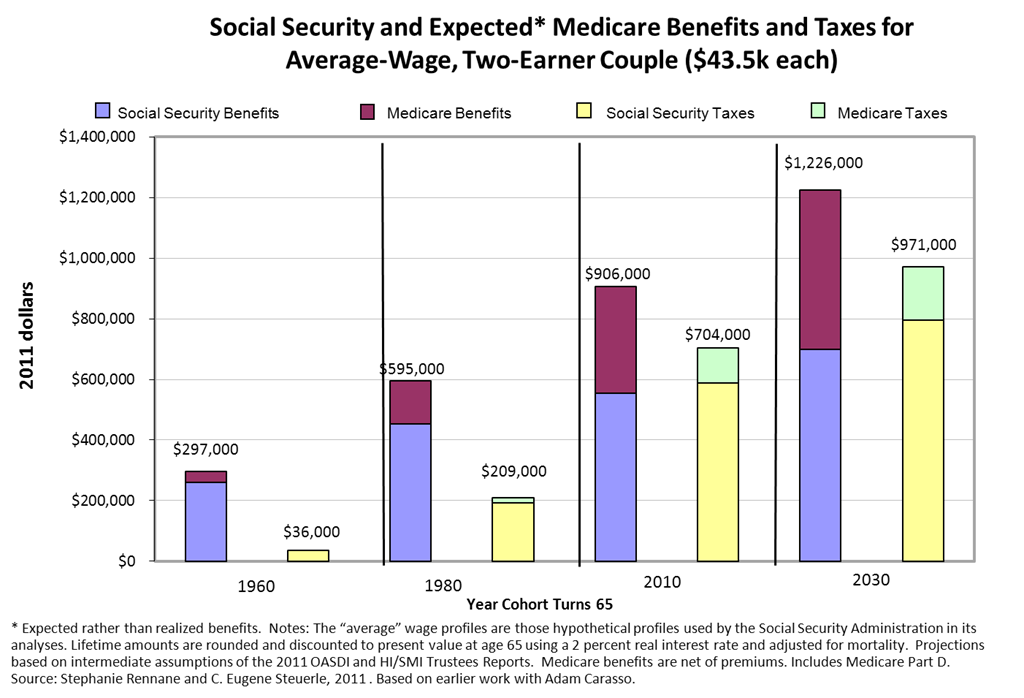
According to an Urban Institute research paper, in 2011 a two-earner couple retiring  with a combined income of apx. $87,500 (defined as the average wage), would have paid about $116,000 into the Medicare program during their lifetimes.  That same couple can expect lifetime Medicare benefits of $357,000 net of premiums.  And given the current trajectory, in 2030 an average-earning couple will pay $175,000 in Medicare taxes but receive a benefit of $527,000. 

image

So call it what you will, in the real world where accumulated deficits are resolved through bankruptcy and/or cessation of operations, the phenomenon described above represents a significant funding gap that results in the assessment of financial burden for Medicare expenditures on a broad base of the population not receiving benefits.  That sure sounds like an entitlement, does it not?

Regardless of what it’s called, the problem with raising the age of Medicare eligibility as a policy solution aimed at closing the funding gap is that it only avoids expenditures for those seniors otherwise able to afford healthcare.  This presents both fairness and pragmatic challenges.  For those individuals in the 65 – 67 age cohort unable to pay the cost of their healthcare, some form of cost subsidy will still be required: whether that is through Medicaid, insurance premium subsidization under the Affordable Care Act or cost shifting in lieu of uncompensated care.

Those challenges are causing some members in Congress to consider Medicare means testing as a potential alternative to raising the eligibility age.  This is an idea that President Obama has also publicly supported in the past.  The approach would lower Medicare benefits as a function of income.  From a purely economic vantage this is a more efficient approach because there is a much higher correlation between the targeted  population of the policy and the desired financial impact on the Medicare program.

Means testing will not be not an easy sell politically, however, when considering the enormous amount of political clout held by that portion of the electorate to be affected.  The media monster that is AARP will almost certainly be effective in portraying any attempt to implement means testing as robbing from the vulnerable elderly.  No easy answers here, folks.

Way back in the day, I used to do a lot of work as a financial advisor and was involved in several debt restructurings.  What I learned through that experience was the best possible outcome meant having all parties involved equally dissatisfied with the result.  I wonder if that’s a scenario that anyone in Washington could possibly accept where a deal on the Fiscal Cliff is involved.

Cheers,
  Sparky

Big Data Assimilation

In early October, I wrote a post entitled, Big Data and Brand Management.  In observing the Pub’s recent visit tracking activity that post has been getting some attention – particularly from the Netherlands.  I wish I had the time to investigate further to possibly understand why.

I do know that the subject of Big Data and Healthcare is quickly becoming one of the most intriguing – if not controversial, and to many, threatening – side shows of the big show that is Healthcare Reform and the impending implementation of the Affordable Care Act.

In the IT world this growing attention is seen as an anticipated awareness among the less informed masses to a level of consciousness they achieved over a decade ago.  But for all that foresight, there has been precious little headway made in addressing some very critical issues of access and security.  And that is because those issues are not clearly defined, have dramatic implications regarding personal privacy and must be framed within a context of assumptions about the future that are widely debatable and lacking entirely for empirical support.

There is a lot at stake here:  a huge potential for solving some very challenging social problems – yet just as great potential for infringing upon personal liberty.  While I share the justifiable concern over protecting the privacy of individual patient data and information, I believe that concern is clouding an even greater story here; and that is the alluring diagnostic trajectory that Big Data has launched us upon.

In combining Big Data (large static storage requirements) with highly complex  analytical algorithms (large dynamic memory capacity) requiring tremendous computing capacity (processing speed) what we are essentially doing is seeking to replicate and accelerate the thinking ability of the human brain.  The historically great equalizer of human intelligence has been a life’s experience.  To be sure, there are ways to broaden exposure to circumstances and events that contribute to such experience, but there is no way to accelerate the natural course of observable events, which ultimately comprise the sum total of that experience – nor the wisdom of maturity to make good use of it.

In the book, Blink, by Malcolm Gladwell, he explains the concept of rapid cognition: a fascinating treatise on how our minds instantaneously sort through and combine billions of observational data elements from our life’s experience, analyze the meaning of that data and then form a reasoned judgment about what we have just observed through our senses in a matter of a few seconds.  This is often also referred to as intuition, or a gut feel.  It’s something that has saved many lives owing to physicians’ diagnostic capabilities.

What many clinicians fear in a world of Big Data is an unproven overreliance on information technology to supplant or replace that diagnostic capability (or intuition, if you will).  While, in the aggregate, some of that concern may understandably be driven by a fear of professional obsolescence, I think the much more prevalent concern is challenging whether and when a machine will (ever) be able to truly replace the intuitive capability of the human mind.

And that really is at the heart of the longer-term Big Data dilemma, even if the focus right now is on privacy and protection.  I don’t mean to diminish such concerns, but I do believe we will ultimately be able to address those relevant concerns satisfactorily.

A much more difficult challenge, however, is assessing and understanding whether machines will eventually be able to capture the collective human knowledge and experience that clinicians currently rely upon and be able to analyze and apply that information in a way that achieves better overall patient outcomes than application of human assessment, analysis and reasoning.  And, if so, will patients be able to have access to that computing capability without needing human interface?

Then, what is the role of doctors in the future? Will there be a need for them? Will those who would have otherwise employed their talents in becoming physicians be the future engineers and programmers that work to develop, upgrade and enhance the computing capability of the new electronic caregivers?

A lot to think about.  Big Data offers a lot bigger challenges than just worrying about who owns the data.  The real concern is who is going to control the owner of the data – and how? Star Trek fans, think Borg.  Is that where we’re headed?

What do you think?

Cheers,
  Sparky

Announcing New Discussion Group

Artower Advisory Services is pleased to make available for free participation a new online discussion group on the subject of US Healthcare Public Policy.  A number of the initial members, including myself, represent a cadre of individuals that have participated together in a similar discussion group for well over a decade.  Registration is open now, and the group will officially kick off on November 24th.

For my own part, I first joined that predecessor group in 1996 (if challenged memory serves).  And over that span I have learned more useful knowledge on a variety of topics related to Healthcare Reform and Healthcare Public Policy than any other resource.  The reasons for this have to do with the diverse backgrounds, experiences and ideological vantages represented by the group participants – as well as the unfettered and forthright manner in which ideas can be shared, challenged and debated.

I had initially hoped that the Policy Pub would serve as a platform for creating an online environment where clients and colleagues of Artower Advisory Services could participate in an online community and learn from one another’s experiences, thoughts and ideas.  While I have been more than pleased with the attention this blog has received, I have thus far been unable to translate that success into an online community.

So I took advantage of a recent opportunity to germinate a new discussion group with individuals that I know from personal experience are very knowledgeable, very passionate and very eager to tackle fresh meat (perhaps that is stating the case a bit harshly – but please join and decide for yourself).  To join the group, just click on the picture above, and you will be taken directly to the online registration page.  All the information you need to read and share posts can be found there.  Before joining, please read the Discussion Group Guidelines.

As for the Pub, I will continue posting what I hope you will find interesting, useful and maybe occasionally entertaining.  I will also continue to focus my posts on affordable housing, home-and-community-based services and post-acute/long-term care, while the discussion group will encompass topics in healthcare much more broadly.  While there may be future opportunities to cross reference the Policy Pub and the discussion group, they are independent initiatives, and the success of either is not dependent upon the other.

I hope you will consider joining the US Healthcare Policy Discussion Group and benefit from such participation as much as I have during my professional career.

Cheers,
  Sparky

WARNING: Fiscal Cliff Ahead

The topic of a fiscal cliff may be only indirectly related to Healthcare Reform – but that is sort of like saying Hurricane Sandy only indirectly impacted the entire Northeastern United States because it only directly hit the coast of New Jersey (and I make that observation having lost a 40-foot pine tree to Sandy – and I live in Northeast Ohio).

Metaphorically and practically, the fiscal cliff represents a whole lot more than just a short path to economic collapse of the U.S. economy – as if that prospect would need a heightened sense of awareness and urgency.  Want to up the ante further? How about if the U.S. economy collapses, then very likely so too does the rest of the world’s economies: global recession.  Got your attention now?

What is the Fiscal Cliff?
The fiscal cliff is a term used to describe the anticipated financial/budget situation beginning next month resulting from mandated tax increases and spending cuts.  The Bush tax cuts will expire on December 31st of this year, as will the Social Security payroll tax holiday.  At the same time, several tax policies that have historically reduced individual and business tax burdens are due to expire, while several new tax provisions of the Affordable Care Act will take effect in January 2013.

On the spending side, the Budget Control Act of 2011 requires automatic spending cuts to begin on January 2nd (the sequester cuts that you have probably read about); extended unemployment benefits are due to expire at year’s end; and – somewhat less than indirectly related to Healthcare Reform – rates at which Medicare pays physicians will decrease by nearly 30% on December 31st.

What Does it Mean?
In total, the Congressional Budget Office forecasts the impact of the fiscal cliff to be a net reduction of $607B to the federal deficit in FY 2013.  Reducing the deficit is generally perceived as a good thing, right?  “Not so fast, my friend,” as Lee Corso says on College Gameday.   Most economists share a grave concern that the sudden onset of these austerity measures would send the U.S. economy into a double-dip recession. 

But most economists and financial analysts also agree that simply legislating additional delays to these measures – the proverbial kicking the can down the road again – is not going to be in the best long-term interests of the economy and will only serve to increase the stakes and consequences of an eventual fiscal collapse.  And, as we know, those charged with addressing this conundrum – elected officials, particularly in the House – tend to be long-term thinkers for only a very short period of time following an election.   And thus the stage is set.

The Election Mandate: COMPROMISE
Within a very short span of time we will learn what the next two years are going to look like in Washington. With both political parties claiming an election mandate that was clearly given to neither let’s see how long the rhetorical posturing and positioning in the media will last – and whether both parties have finally come to realize that the only mandate they were given was to stop sparring like children vying for parental attention and accomplish something meaningful!

There have been early signs of a willingness to compromise.  Republican party strategists that want to seize the new leadership void left in the wake Tuesday’s election will look to distance themselves from Grover Norquist and the Tea Party.  They appear to be willing to trade tax increases for spending cuts (as in, compromise – the way things used to get done in Congress).

In maintaining a Republican stronghold of the House, I believe voters have signaled to Democrats that fiscal conservatism is a pervading belief of the electorate.  Most political observers I think agree that entitlement spending has to be at the center of any meaningful discussion on debt reduction.  And not just at the periphery based upon an assessment of how to minimize constituency impact.  Democrats are going to have to agree to spending cuts that won’t guarantee them automatic reelection.

How this plays out over the next month leading into the holiday recess will have tremendous ramifications in setting the tone and demeanor of the 113th Congress.  And that, in turn, will have tremendous ramifications on the implementation of the Affordable Care Act.  See – took me a while, but I brought it back home.

Cheers,
  Sparky